

Painting a rental property is generally a currently deductible repair expense under US tax rules, and the landlord pays it. That is the bottom line. Unless the paint job is bundled into a larger renovation that adds value or extends the property’s useful life, you deduct the full invoice cost on Schedule E in the year you pay it. Tenants cover painting costs only when they cause damage beyond normal wear and tear.
Before you call a painter or pick up a brush, three things matter most:
- Document everything. Dated move-in and move-out photos, itemized invoices, and a written condition report are what protect you in a deposit dispute or an IRS audit.
- Keep painting invoices separate from any concurrent renovation work. A single bundled invoice can accidentally push a deductible repair into capitalizable improvement territory.
- Run the vacancy math first. A two-week vacancy at typical market rent costs a substantial amount in lost rent. That often exceeds the cost of a proactive paint job scheduled during the tenant’s notice period.
Painting is also, consistently, one of the highest-ROI maintenance investments a landlord can make. Fresh walls improve showability, support rent premiums, and reduce the time a unit sits empty.
Table of Contents
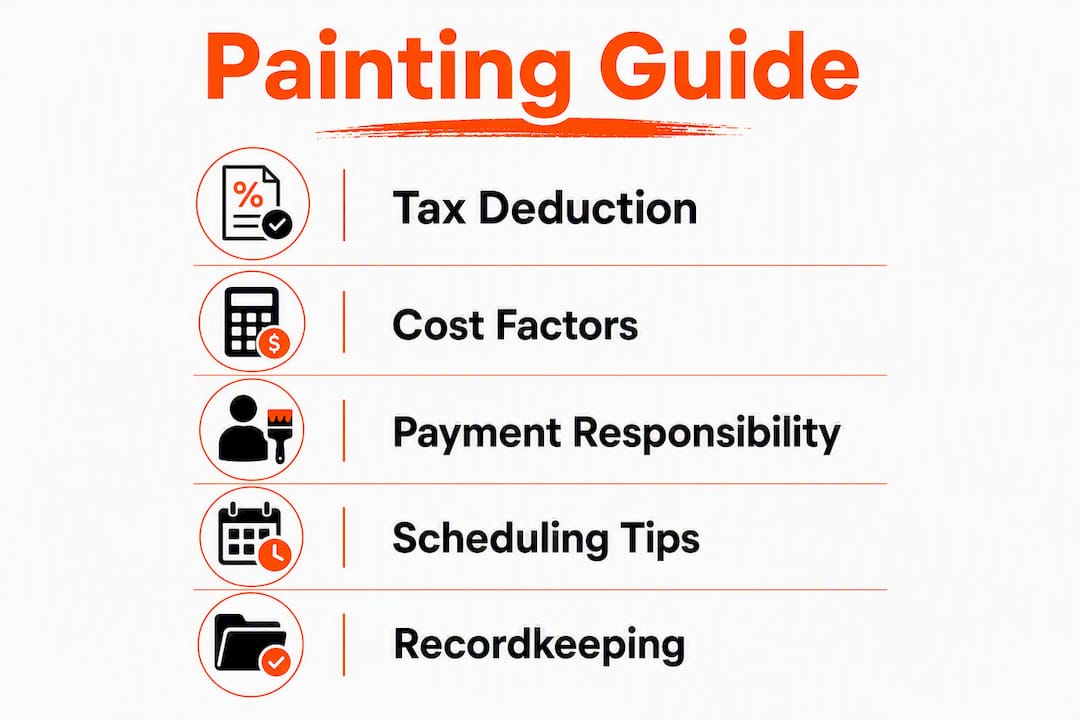
- How does the IRS treat painting on a rental property?
- What does it typically cost to paint a rental unit?
- Who pays for painting: landlord, tenant, or both?
- When should you paint? Timing, frequency, and vacancy ROI
- What records do you need for taxes and deposit disputes?
- Checklist before you hire a painter or pick up a brush
- Key takeaways
- The case for treating painting as scheduled maintenance, not a reaction
- A landlord’s perspective on getting painting right
- Authoritative sources for landlords
- Why landlords who want consistent results work with a professional crew
How does the IRS treat painting on a rental property?
The IRS draws a clear line between repairs and capital improvements, and that line determines whether you deduct the cost this year or depreciate it over 27.5 years under the residential rental property schedule.
A standalone repaint or touch-up is a repair. You deduct it in the year paid on Schedule E (Form 1040). IRS Publication 527 covers this directly: routine maintenance that keeps a property in its ordinary operating condition is currently deductible, not capitalized.
The problem arises when painting is part of something bigger. If you gut a kitchen, replace flooring, and repaint the entire unit as part of one coordinated project, the IRS may treat the whole scope as a capital improvement. In that case, painting costs bundled into the project get depreciated over 27.5 years alongside the other work, not expensed immediately.
| Scenario | Tax treatment | Bookkeeping action |
|---|---|---|
| Standalone repaint between tenants | Current repair expense | Deduct on Schedule E in year paid |
| Touch-up during tenancy | Current repair expense | Deduct on Schedule E in year paid |
| Painting bundled with full kitchen remodel | Capitalizable improvement | Depreciate over 27.5 years |
| Painting as part of a unit addition or major structural work | Capitalizable improvement | Depreciate over 27.5 years |
The practical fix is simple: get a separate line item for painting on every invoice, even when other work is happening simultaneously. An invoice that reads “Interior repaint: $1,400” alongside “Kitchen cabinet replacement: $6,200” gives your accountant the documentation to treat each item correctly. One lump-sum invoice for “renovation work: $7,600” does not.
A sample journal entry for a deductible repaint looks like this: debit Repairs and Maintenance $1,400, credit Cash (or Accounts Payable) $1,400. For a capitalized improvement, the debit goes to the property’s asset account, and annual depreciation entries follow.
What does it typically cost to paint a rental unit?

Cost ranges vary significantly by region, unit size, and scope of work. As a general benchmark, studio and one-bedroom units can cost several hundred to a few thousand dollars for a full interior repaint, with larger units costing more in many US metro areas. Those numbers move based on several variables.
What drives the price up or down:
- Prep work. Patching nail holes, skim-coating damaged drywall, and sanding glossy surfaces before painting adds time and cost but is what separates a paint job that lasts five years from one that peels in eighteen months.
- Primer and stain-blocking. Smoke damage, water stains, and crayon marks require a dedicated sealer coat before topcoat. Skipping it means the stain bleeds through within months.
- Number of coats. Most quality repaints require two finish coats. Switching from a dark tenant color to a light neutral may need three.
- Trim, ceilings, and doors. These are priced separately and add meaningful time. A full unit repaint including ceilings and trim costs noticeably more than walls only.
- Specialized coatings. Mildew-resistant paint for bathrooms and kitchens, low-VOC formulas for occupied or recently vacated units, and lead-safe protocols for pre-1978 buildings all add to the quote.
- Lead-safe requirements. Properties built before 1978 may trigger EPA Renovation, Repair, and Painting (RRP) rule requirements, which mandate certified contractors and specific containment procedures when painted surfaces are disturbed.
Labor typically accounts for a large portion of a painting job’s total cost, which means the crew you hire matters more than the paint brand you specify. A faster, experienced crew reduces vacancy days, and that saving often offsets a higher hourly rate.
Pro Tip: Spend more on prep and a quality washable paint the first time. A satin or eggshell finish in a durable formula (Benjamin Moore Regal Select or Sherwin-Williams Duration are widely used in rental contexts) holds up to cleaning, resists scuffs, and extends the repaint cycle by a year or two. That extra $200–$300 upfront routinely saves a full repaint cycle over a ten-year hold.
Who pays for painting: landlord, tenant, or both?
The default answer is the landlord. Routine repainting caused by normal use of the property is the landlord’s cost, full stop. Where it gets complicated is when a tenant leaves the unit in worse shape than normal aging would explain.
Normal wear and tear vs. tenant damage
Normal wear and tear includes minor scuffs, small nail holes from picture hanging, and gradual fading. Courts and state landlord-tenant statutes consistently treat these as the landlord’s responsibility. Tenant-caused damage is something different: unauthorized paint colors, large crayon murals, smoke staining throughout the unit, or holes that required patching before repainting.
Many local court standards treat paint in a rental as having a useful life of a few years for charging purposes. If a tenant lived in a unit for several years and the walls show normal aging, charging them for a full repaint is unlikely to hold up in small-claims court. If that same tenant painted the living room an unauthorized color and left relatively quickly, you may have a defensible claim.
Landlords commonly misapply repaint charges. The defensible standard is damage above normal wear and tear, documented with dated move-in and move-out photos and an itemized contractor invoice showing what the damage required. Without that paper trail, most small-claims judges will side with the tenant.
Lease language that protects you
A few clauses worth including in your lease:
- A neutral-color policy specifying the approved paint color and sheen for the unit, with a requirement to restore to that standard upon move-out if the tenant paints.
- An explicit approval process for tenant painting, including written landlord consent and color approval before any work begins.
- A damage clause distinguishing tenant-caused damage from normal wear, with reference to the move-in condition report as the baseline.
Pro Tip: At move-in, photograph every wall, ceiling, and door at close range and wide angle. Store photos with a timestamp in a cloud folder labeled by unit and date. This takes twenty minutes and is the single most effective thing you can do to win a deposit dispute.
When should you paint? Timing, frequency, and vacancy ROI
Industry guidance consistently points to a several-year repaint cycle as the standard for rental interiors, adjusted for tenant length, traffic, and unit condition. In practice, most landlords use one of three approaches.

Turnover-driven: repaint only when a tenant leaves and the unit needs it. Works well for long-term tenants in well-maintained units but can lead to reactive scheduling and higher vacancy.
Fixed-cycle: repaint every three to five years regardless of turnover. Predictable for budgeting, easier to schedule in advance, and tends to keep units consistently presentable.
Condition-based: assess at each turnover and repaint when condition warrants it. The most cost-efficient approach for experienced landlords with good documentation habits.
The vacancy-cost calculation
Delaying a paint job can cost more than the job itself when vacancy time is factored in. A unit renting at $1,800/month generates roughly $60/day. A delay of a couple of weeks because painting wasn’t scheduled during the notice period can result in substantial lost rent. Most interior repaints for a one-bedroom unit cost less than $840 in many US metro areas.
The math favors proactive scheduling almost every time.
Ideal scheduling timeline
- 60 days before lease end: confirm tenant’s move-out date and begin assessing scope (touch-up vs. full repaint).
- 30–45 days out: book the painting crew. Booking during the tenant’s notice window avoids peak-season delays and locks in your preferred contractor.
- Move-out day: conduct the move-out inspection, photograph everything, and hand over access to the painting crew the same day or the next morning.
- Painting complete: schedule cleaning, carpet cleaning, and any other trades in sequence so they don’t overlap.
- Listing day: unit is market-ready with fresh paint, clean surfaces, and updated photos for the listing.
Pro Tip: Coordinate your lease end dates to avoid summer peak season if possible. Painters are booked weeks out from May through August in most US markets. A lease ending in October or February gives you faster scheduling, often better pricing, and a crew that isn’t stretched thin.
What records do you need for taxes and deposit disputes?
Good recordkeeping does two jobs: it supports your Schedule E deduction if the IRS asks, and it gives you the evidence to win a deposit dispute if a tenant pushes back.
| Record type | Purpose | Retention period |
|---|---|---|
| Dated move-in photos | Establish baseline condition | Duration of tenancy + 3 years |
| Dated move-out photos | Document damage beyond wear and tear | 3 years after tenancy ends |
| Move-in/out inspection checklist | Written condition record signed by tenant | 3 years after tenancy ends |
| Itemized contractor invoice | Supports tax deduction and deposit claim | 3–7 years (match tax return period) |
| Proof of payment (bank statement/receipt) | Confirms expense was paid | 3–7 years |
| Lien waiver (for larger jobs) | Protects against contractor liens | Duration of property ownership |
For bookkeeping, the key discipline is keeping painting costs on a separate line from other renovation work. When a painting invoice arrives alongside a plumbing or flooring invoice, record each separately in your accounting software. In QuickBooks or a similar platform, code painting to a “Repairs and Maintenance” expense account, not to the property’s asset account, unless your accountant has confirmed it qualifies as a capital improvement.
Store everything digitally. A cloud folder organized by property address, then by year and tenant, makes retrieval straightforward whether you’re responding to an IRS notice or a small-claims filing.
Landlords who misapply charges often lose deposit disputes not because they were wrong on the facts, but because they couldn’t produce the documentation. Dated photos and itemized invoices are what convert a legitimate claim into a winning one.
Checklist before you hire a painter or pick up a brush
Before you decide scope:
- Measure the paintable area (walls, ceilings, trim separately) to get accurate quotes.
- Walk the unit and list every repair needed before painting: holes, cracks, water stains, mold spots.
- Decide touch-up vs. full repaint based on condition, tenant length, and time since last paint.
- Confirm the current color and sheen so you can match or standardize.
When vetting contractors:
- Verify general liability insurance and workers’ compensation coverage before signing anything.
- For pre-1978 buildings, confirm the contractor holds EPA Lead-Safe Certification (RRP certification).
- Ask for references from other rental property clients specifically, not just residential homeowners.
- Get a written quote that specifies scope (which rooms, walls only or ceilings and trim, number of coats, prep included), timeline, and payment terms.
On-site preparation:
- Remove or cover furniture and fixtures the tenant left behind.
- Confirm adequate ventilation, especially for occupied adjacent units.
- Coordinate cleaning to happen after painting, not before.
- Check whether any local permits are required for the scope of work (rare for interior repaints, more relevant for exterior work in some jurisdictions).
DIY vs. pro decision:
- DIY saves money on labor but adds days to your vacancy window. A professional crew completes a one-bedroom repaint in one to two days; a solo landlord often takes a weekend or more.
- Quality and finish consistency matter for showability. Brush marks, roller texture inconsistencies, and missed cut lines are visible in listing photos.
- If the property has lead paint risk (pre-1978 construction), DIY is not advisable without proper training and equipment. EPA RRP rules apply to contractors, but the health risk applies to anyone disturbing lead paint.
- For a portfolio of units, a standing relationship with a professional crew that knows your color standards and scope expectations saves time on every turnover.
Key takeaways
Rental property painting is deductible as a current repair expense when invoiced separately from larger renovation projects, and proactive scheduling tied to the tenant’s notice period is the single most effective way to reduce vacancy cost.
| Point | Details |
|---|---|
| Tax treatment | Standalone repaints are deductible on Schedule E in the year paid; bundled renovation work must be depreciated over 27.5 years. |
| Tenant charges | You can charge tenants only for damage beyond normal wear and tear, supported by dated photos and itemized invoices. |
| Repaint frequency | A 3–5 year cycle is the standard for rental interiors; condition-based assessment at each turnover is the most cost-efficient approach. |
| Vacancy ROI | Book painters during the tenant’s notice period; a two-week vacancy at $1,800/month costs roughly $840 in lost rent, often more than the paint job itself. |
| Capeapexpainters | For landlords who want prep-first, in-house crew quality with consistent results across turnovers, Capeapexpainters offers professional painting services built around property-owner needs. |
The case for treating painting as scheduled maintenance, not a reaction
A landlord’s perspective on getting painting right
Most landlords treat painting as something they deal with after a tenant leaves. That reactive mindset is where the money leaks out. By the time you’re standing in a vacant unit deciding whether to repaint, you’ve already lost the scheduling advantage. The painters are booked out three weeks, your listing is delayed, and the vacancy clock is running.
The landlords who handle this well treat painting the same way they treat insurance renewals: it goes on the calendar before it becomes urgent. They know their repaint cycle, they have a contractor relationship in place, and they book during the notice period so the crew walks in the day after move-out. That discipline alone, applied consistently across a portfolio, is worth more than any particular paint brand or color choice.
Standardizing one neutral color and sheen across all units is the other move most landlords underestimate. Keep a gallon of your standard color at each property. Touch-ups between tenants take an hour instead of a day, and you never have a visible patch mark in a listing photo. It sounds like a small thing. Over ten units and five years, it saves real money and real time.
The documentation habit matters just as much. Landlords who lose deposit disputes almost always had a legitimate claim. They just couldn’t prove it. Twenty minutes with a phone camera at move-in and move-out, stored in a labeled cloud folder, is the difference between recovering $800 in painting costs and absorbing it.
Treat painting as a scheduled business expense with a known ROI, document it properly, and the tax treatment takes care of itself.
Authoritative sources for landlords
These are the primary references worth bookmarking if you want to go deeper on any of the topics covered above.
IRS Publication 527 — Residential Rental Property: The IRS’s own guide covering what qualifies as a deductible repair versus a capital improvement, depreciation rules for residential rental property, and Schedule E filing guidance. Start here for any tax question about painting or maintenance costs.
EPA Renovation, Repair, and Painting (RRP) Rule: If your rental was built before 1978, this is the governing federal rule on lead-safe work practices. It covers contractor certification requirements, tenant notification obligations, and containment procedures. Non-compliance carries significant penalties.
Paint Pro New England — Rental Property Painting Schedule: A practitioner guide with regional pricing examples, scheduling tactics, and turnover-compression strategies for landlords managing units in metro markets.
ProFlow Painting Sacramento — Landlord Costs and Rules: Covers state-level examples of wear-and-tear versus tenant-damage distinctions, useful-life standards for deposit deductions, and what documentation holds up in small-claims proceedings.
Randall’s Rental Painting FAQ: Practical guidance on repaint cycles, color standardization, and portfolio-level painting strategy for landlords managing multiple units.
Why landlords who want consistent results work with a professional crew
Fresh paint is the fastest way to make a rental unit show well, and the difference between a paint job that lasts two years and one that lasts five almost always comes down to preparation. That’s where most DIY attempts and budget contractors fall short: they skip the skim-coating, skip the primer, and apply topcoat over surfaces that aren’t ready for it.

Capeapexpainters takes a prep-first approach on every job, with a full-time in-house team rather than rotating subcontractors. That means the same crew, the same standards, and the same accountability on every project. For landlords managing properties in Cape Town, the Cape Winelands, and the Overberg, that consistency across turnovers is exactly what reduces rework and keeps vacancy windows short.
If you’re ready to schedule a repaint or want a quote for your next turnover, contact Capeapexpainters for an in-person assessment and written scope. The conversation starts with a property walkthrough, not a generic price list.
Recommended