
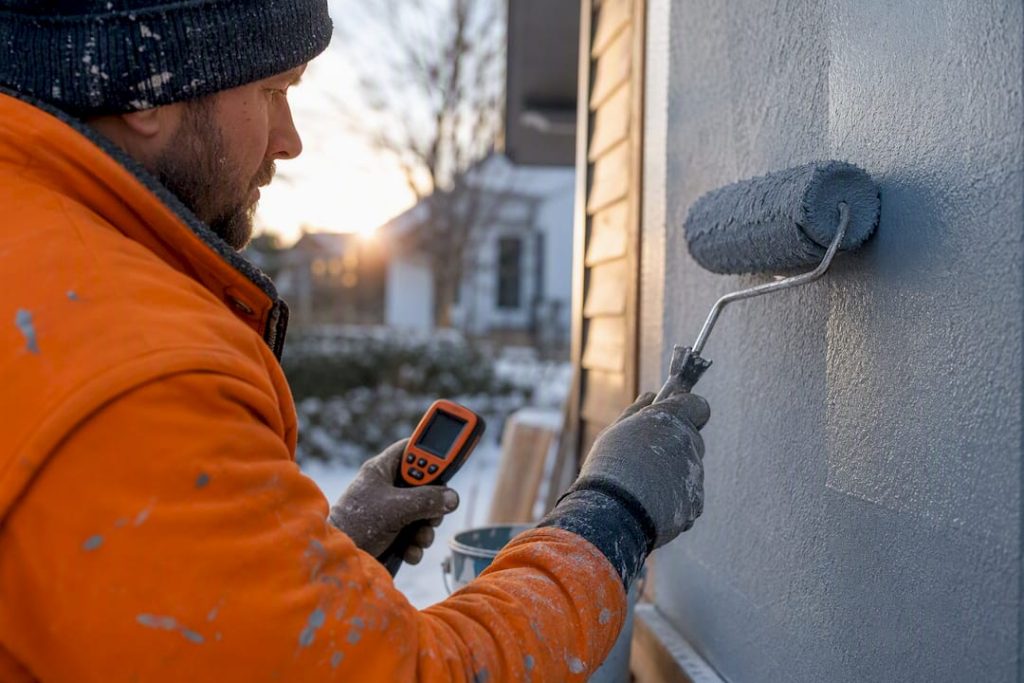
Yes, you can paint in winter, but three checks decide whether the job holds up: the paint’s minimum application temperature, the actual surface temperature, and the forecast for the next 24 to 48 hours. Skip any one of them and you risk a coat that looks fine in December and peels by March.
Before you open a can, work through this:
- Read the label. Every paint has a printed minimum application temperature. Do not guess it.
- Point an infrared thermometer at the wall, not the air. Surface temperature is what actually matters.
- Check the overnight low and dew point for the next day or two. A cold snap or dew after application can undo the whole job.
Key Takeaways
Winter paint jobs succeed or fail based on three measurements, not the calendar: the product’s minimum temperature, the surface reading, and the dew point margin held through the full cure window.
| Point | Details |
|---|---|
| Check the can first | Minimums range from about 10°C for standard latex down to 2°C for cold-weather acrylics. |
| Measure the surface, not the air | Use an infrared thermometer since surfaces can run several degrees off the ambient temperature. |
| Keep a dew point margin | Maintain the surface at least 3°C (5°F) above the dew point through the first 24 to 48 hours. |
| Expect longer recoat times | Cold can push interior recoats to 6 to 12+ hours and exterior recoats past 24 to 48 hours. |
| Bring in a pro for risky exterior jobs | Capeapexpainters uses in-house crews with diagnostic surface checks and climate-specified coatings for winter exteriors. |
Where to verify these numbers yourself
Manufacturer technical sheets remain the final word on any paint’s minimum application temperature, so check the specific product page before buying. For weather and dew point data, a reliable forecasting service or an authority like the Met Office gives the overnight lows and humidity trends you need to plan a cure window. An infrared thermometer and a basic moisture meter round out the toolkit; both cost little and remove most of the guesswork covered in this guide.
Table of Contents
- How cold weather slows paint drying
- What temperature and dew point rules actually apply?
- Which paint should you use for low temperature painting?
- How to speed drying indoors without ruining the finish
- Prepping surfaces so frost and dew don’t ruin the job
- How long does paint take to dry and cure in cold weather?
- Why hire a professional for winter exterior painting?
- Frequently asked questions
- Sources
How cold weather slows paint drying
Paint doesn’t just dry, it cures, and those are two different processes. Drying is simple evaporation, the solvent or water leaving the surface. Curing is the paint’s binder particles fusing together into a continuous film, a process called coalescence, and that fusion needs warmth to happen properly.
Cold slows both, but curing suffers more. A wall can feel dry to the touch within an hour in winter while the binder underneath is still weeks away from fully fusing. That gap is where trouble hides. A coat applied below its rated minimum can look acceptable on application day and still delaminate months later because coalescence never finished. Touch-dry is not the same as cured, and treating it that way is the single most common mistake in cold-weather painting.
What temperature and dew point rules actually apply?
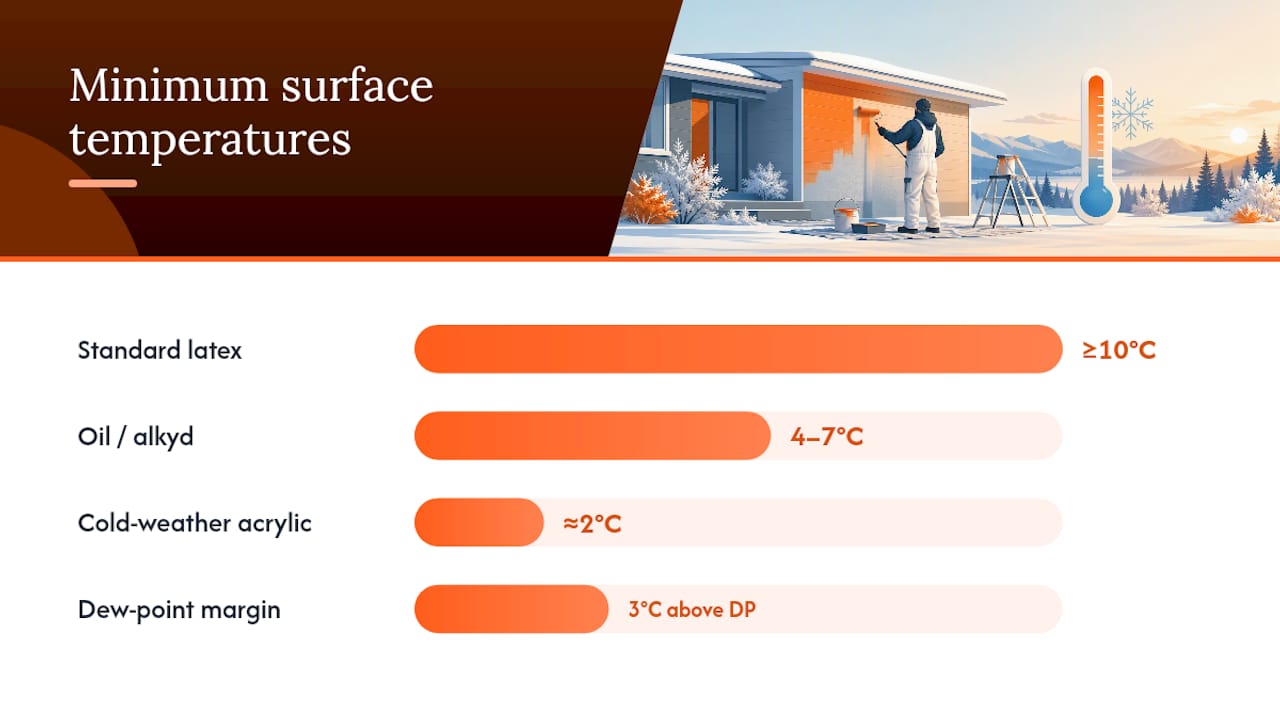
Manufacturers publish minimums for a reason, and they vary more than most people expect. Standard latex paint generally needs air, surface, and material temperatures above 10°C (50°F), while oil and alkyd paints tolerate somewhat cooler conditions, often down to 4 to 7°C (40 to 45°F). Purpose-built cold-weather acrylics push that floor lower still, with some formulations rated to roughly 2°C (35°F).
Surface temperature, not air temperature, is what determines whether paint cures correctly. A wall in direct morning sun can read 8°C warmer than the surrounding air; a shaded wall can sit well below it. That’s why keeping the surface at least 3°C (5°F) above the dew point matters as much as clearing the paint’s minimum. Fall below that margin and invisible condensation can form on the surface during the cure window, wrecking adhesion before you’d ever notice.
- Check the can for the exact minimum, since it varies by product line.
- Use an infrared thermometer on the actual substrate, not a guess based on the weather app.
- Track the dew point and overnight low for 24 to 48 hours after painting, not just the day itself.
Pro Tip: An infrared thermometer costs less than a gallon of premium paint and pays for itself the first time it stops you from painting a wall that’s five degrees colder than the air around it.
Which paint should you use for low temperature painting?
Cold-weather formulations exist for a reason: they extend the season, not eliminate the need for judgment. Some exterior acrylics are engineered for application down to about 2°C (35°F), using modified resins that coalesce at lower temperatures than standard latex. That buys you weeks of extra working season, but the label’s minimum is still a hard floor, not a suggestion.
Oil and alkyd paints tolerate cold better than water-based paints in general, since they don’t rely on water evaporation to trigger film formation. The tradeoff is longer overall cure times and stronger odor, which matters for occupied interiors.
- Choose a cold-weather labelled product when temperatures will hover near a standard paint’s minimum.
- Avoid drying accelerants unless the manufacturer specifically approves them for that product.
- Never apply paint that has frozen in storage. Frozen paint separates at a chemical level that stirring won’t fix.
- Warm paint gently before use only if the manufacturer says it’s safe. Direct heat near a heater or flame is not the way to do it.
How to speed drying indoors without ruining the finish
Timing gives you free help. Paint during the warmest stretch of the day, generally late morning through mid-afternoon, and plan the job around a clear 24 to 48 hour window rather than just a mild afternoon.
Indoors, heat and airflow have to work together. Warming the room speeds drying, but heat alone does nothing without ventilation, because trapped humid air slows coalescence just as effectively as cold does.
- Set the room to a steady, moderate temperature rather than blasting a space heater at the wall.
- Crack a window or run an extractor fan to let moisture escape instead of recirculating.
- Add a box fan to move air across the surface, and a dehumidifier if the room feels damp.
- For small sheltered outdoor jobs, a temporary plastic enclosure with a radiant heater can work, but keep flame sources well clear of fumes and never seal the space airtight.
Pro Tip: A dehumidifier does more for winter drying than an extra heater. Heat without moisture control just creates a warm, damp box that traps solvent vapor exactly where you don’t want it.
Prepping surfaces so frost and dew don’t ruin the job
Cold weather makes hidden moisture more dangerous, not less. Confirm surfaces are clean, dry, and completely frost-free before you start, and after rain or pressure washing, give timber and masonry longer to dry out than you would in summer. Cold air holds less moisture, but it also releases it more slowly from porous materials.
A moisture meter takes the guesswork out of timber and masonry. If a reading comes back high, delay the job rather than paint over damp substrate; that’s one of the most common causes of early failure regardless of season. Doors and frames deserve particular attention before winter, since seasonal movement in timber can open gaps that trap moisture behind a fresh coat.
- Cover freshly painted surfaces overnight if frost or dew is forecast during the first 24 to 48 hours.
- If dew forms on a coat anyway, let it fully evaporate before recoating rather than wiping it off, which can smear an uncured film.
- Schedule the full job, not just the first coat, around a dry, forecast-clear stretch.
How long does paint take to dry and cure in cold weather?
Recoat windows stretch dramatically once temperatures drop, and the gap catches people who plan a winter job on summer timing. As a rough guide, expect recoat and cure times to roughly double for every 10°C the temperature falls, though the exact number depends on the product and humidity.
| Condition | Warm weather (room temperature) | Cold weather (around 7°C or below) |
|---|---|---|
| Interior water-based, recoat | 2 to 4 hours | 6 to 12+ hours |
| Interior water-based, dry to touch | Under 1 hour | 2 to 4 hours |
| Exterior coats, recoat | 4 to 6 hours | 24 to 48+ hours |
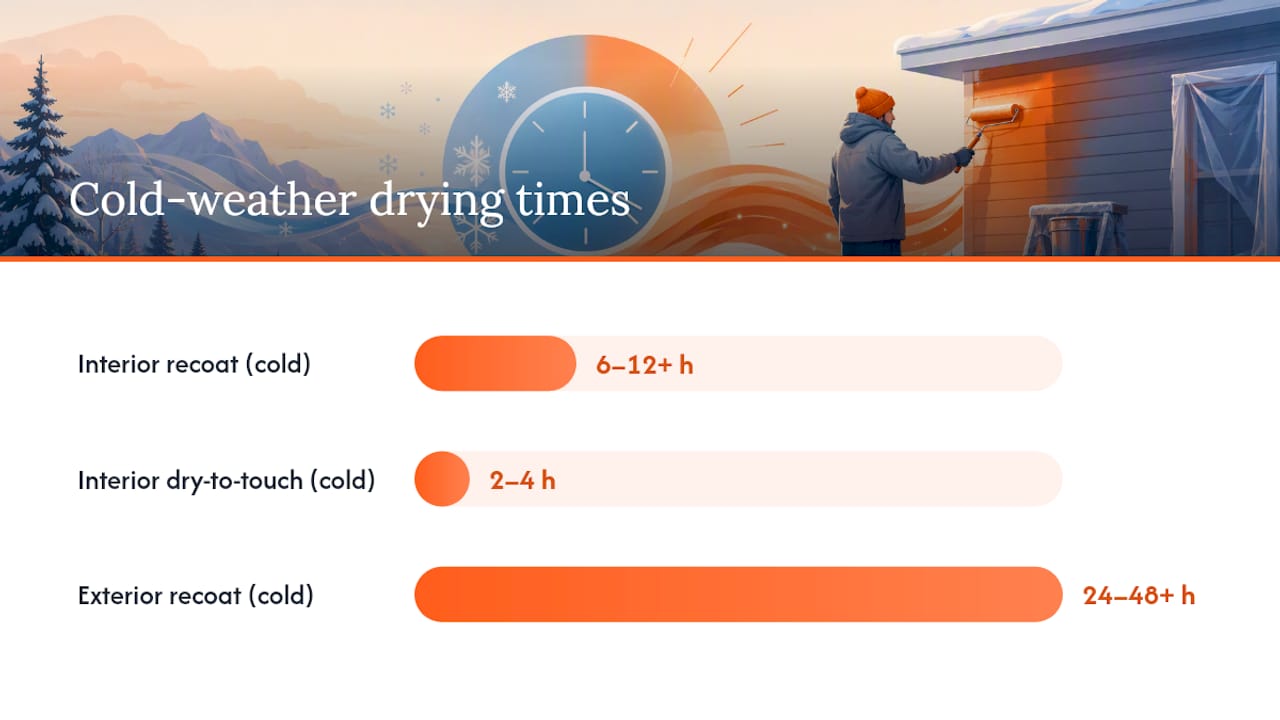
Indoor water-based paint that recoats in 2 to 4 hours at room temperature can need 8 to 12 hours or more at around 7°C, and exterior coats often require extended times between applications in cold conditions, potentially one to two days or more. Judge readiness by touch and appearance, not the clock on the can, and when in doubt, wait longer. Recoating too early traps solvent under the next layer and causes exactly the delamination that shows up months later.
Why hire a professional for winter exterior painting?
Large exterior jobs, damp-prone walls, or coastal salt exposure raise the stakes enough that a professional’s process starts to pay for itself. Capeapexpainters runs an in-house team rather than subcontractors, which means the same crew that does the diagnostic surface assessment also handles the prep, damp-proofing, and final coats, with one point of accountability throughout.
That matters most in winter, when tight weather windows punish guesswork. Prefer a professional when the job is large, when damp or salt air is already a factor, or when a cold spell leaves little room for delay.
A proper winter quote should specify:
- How they’ll verify surface temperature and dew point before starting
- Which low-temperature or cold-weather product they’re specifying, and why
- What cure window they’re building into the schedule before a second coat or handover
A note on patience over haste
Test a small patch first and measure its surface temperature before committing to the whole wall. It sounds obvious, but most winter paint failures trace back to skipping that ten-minute step. Waiting a few extra days for the right window almost always costs less than repainting a job that failed to cure.
Get a winter-ready quote from Capeapexpainters
Capeapexpainters exists for exactly the exterior jobs this article just warned you about: the ones where a missed dew point or a rushed recoat costs far more to fix than to prevent. Instead of guessing at surface temperatures yourself, you get an in-house crew that checks them as standard, specifies climate-appropriate coatings, and builds the cure window into the schedule before work starts.

Before booking any painter for winter work, ask three questions: how will you check surface temperature and dew point, which product are you specifying for these conditions, and what cure time are you allowing before a second coat. If you’d rather have those answers handled for you, request a winter painting quote from Capeapexpainters and get a diagnostic inspection built around your property’s actual exposure, not a generic seasonal estimate.
Frequently asked questions
Can you paint outside in winter at all?
Yes, provided the surface temperature clears the product’s minimum and stays there through the cure window. Cold-weather formulations extend the practical season down to around 2°C.
What’s the minimum painting temperature for most paints?
Standard latex needs roughly 10°C (50°F), oil and alkyd paints tolerate 4 to 7°C, and specialized cold-weather acrylics can go as low as 2°C. The label on your specific can is the definitive source.
Does humidity affect paint drying as much as temperature?
Yes. High humidity slows evaporation and coalescence even when temperatures are acceptable, which is why dew point matters alongside the thermometer reading.
How long should I wait to recoat in cold weather?
Interior water-based paint often needs 6 to 12 hours or more between coats in the cold, versus 2 to 4 hours at room temperature. Exterior coats can need 24 to 48 hours or longer.
Is there such a thing as quick-drying paint for winter?
Cold-weather and low-temperature formulations dry faster than standard paint in the same conditions, but none of them bypass the need for adequate surface temperature and airflow.
Sources
- Painting in cold weather: Temperature minimums and dew point — CompositePaint
- Painting in cold weather | BEHR PRO
- Acrylic paint drying times — BluePea Online
- Can paint dry in cold weather: Local guide — WoodworkingAdvisor