
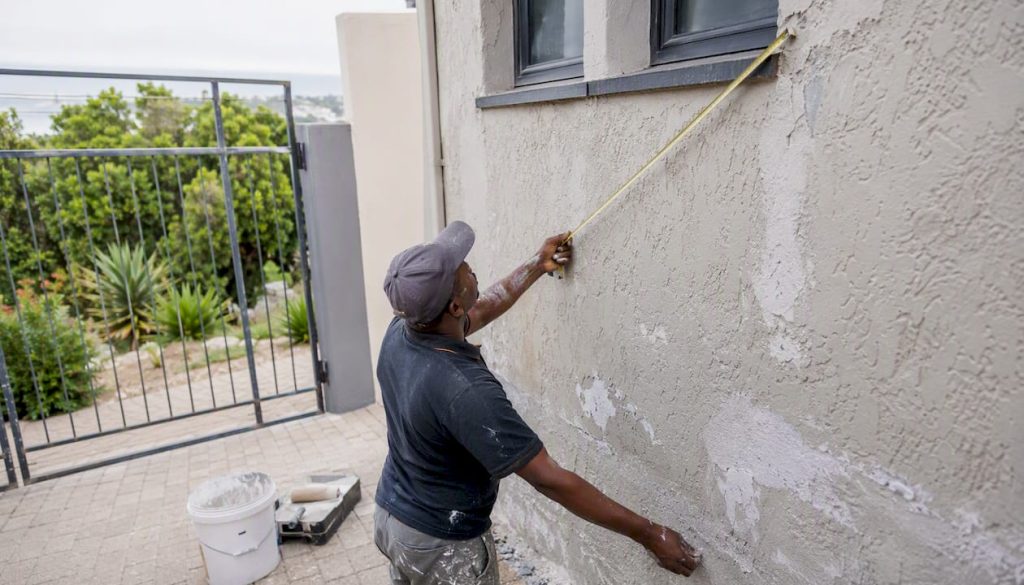
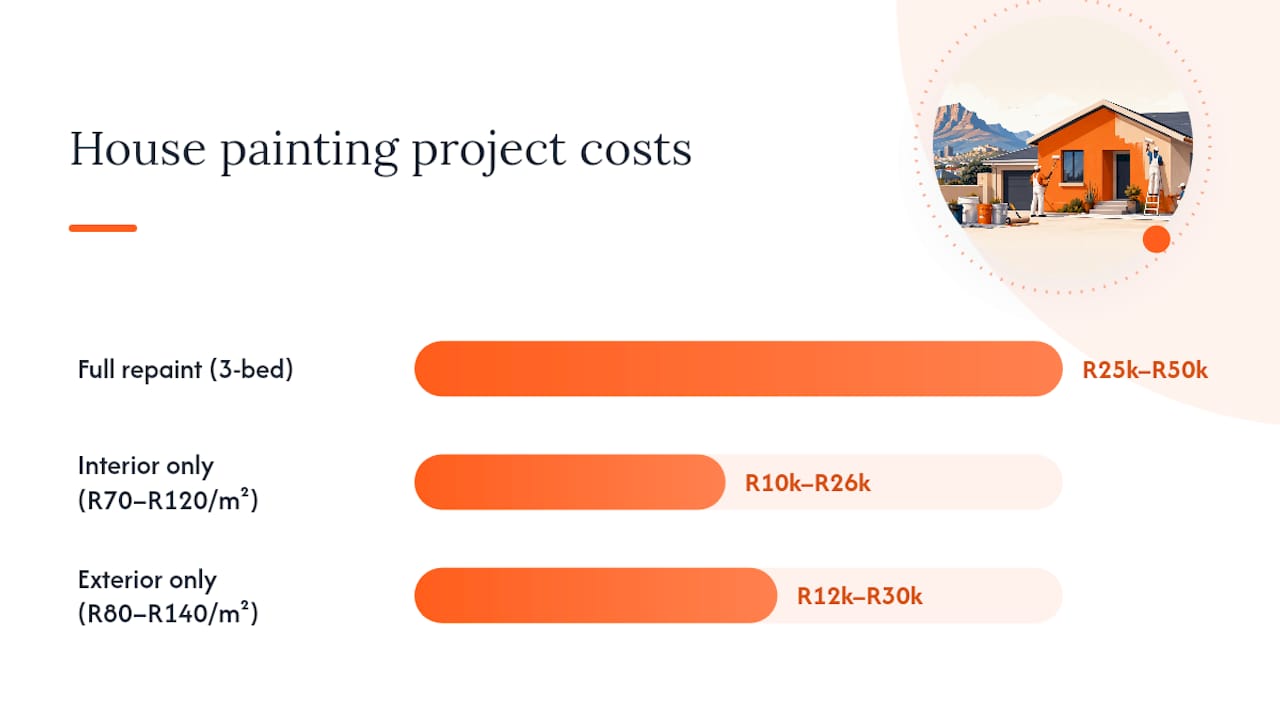
A full interior and exterior repaint of a typical 3-bedroom home in South Africa costs between R25,000 and R50,000 all-in, depending on specification, region, and surface condition. Interior-only jobs run roughly R10,000–R26,000; exterior-only sits around R12,000–R30,000. Those ranges come from national per-m² benchmarks of R70–R120/m² for interior walls and R80–R140/m² for exterior surfaces, labour and materials combined.
Quick reference for a 3-bedroom home:
- Interior only: R10,000–R26,000 (budget to premium specification)
- Exterior only: R12,000–R30,000 (smooth plaster to rough-textured, coastal uplift possible)
- Full repaint: R25,000–R50,000 (varies most with paint quality, prep needs, and access)
What moves each number? For interior jobs, the biggest variables are number of coats and whether new plaster needs sealing. Exterior prices shift most with surface texture, height access, and coastal proximity. A full repaint’s range is wide because it stacks both sets of variables.
Your two immediate actions: measure your paintable wall area (not floor area) and request three itemised quotes from painters who specify the paint brand, product code, and number of coats.
Key takeaways
A 3-bedroom house painting project in South Africa typically costs R25,000–R50,000 for a full repaint, with interior-only jobs running R10,000–R26,000 and exterior-only R12,000–R30,000, based on national R70–R120/m² benchmarks.
| Point | Details |
|---|---|
| National per-m² benchmarks | Interior walls cost R70–R120/m² all-in; exterior surfaces run R80–R140/m², labour and materials combined. |
| Measure paintable area first | Calculate wall area using perimeter × ceiling height minus openings, not floor area, to get accurate quote comparisons. |
| Budget a 10–15% contingency | Hidden damp, failed plaster, or rusted elements discovered during prep regularly add to the quoted total. |
| Coastal and climate uplift | Cape Town and coastal properties typically attract a 10–25% premium for marine-grade primers and mould-resistant coatings. |
| Capeapexpainters | Offers preparation-first residential painting with diagnostic site assessments across Cape Town, Cape Winelands, and the Overberg. |
Table of Contents
- What does house painting cost per square metre in South Africa?
- How to estimate your project area and cost before getting quotes
- What drives the price up or down?
- What a professional quote must include
- How to compare quotes and what red flags to watch for
- How long will your painting project take?
- Where to save and where not to skimp
- Why preparation and local climate matter more than most homeowners realise
- What the painters see that homeowners miss
- Capeapexpainters: preparation-first painting in Cape Town and beyond
- Sources
What does house painting cost per square metre in South Africa?
The table below shows typical ranges you will see on quotes. “Labour-only” means the painter supplies time and equipment; “labour+materials” means they supply and apply the paint system.
Ranges are wide for three reasons. First, a two-coat repaint on sound plaster costs less than a sealer-plus-two-coat system on new or damaged plaster. Second, paint quality matters significantly: a Plascon or Dulux premium product costs more per litre than a builder’s-grade equivalent, and covers fewer square metres per coat. Third, provincial labour rates vary from R35–R60/m² in Gauteng and Cape Town down to R25–R45/m² in KZN and the Eastern Cape, which shifts the labour+materials total accordingly.
Pro Tip: Many painters quote by floor area as a shortcut. A 20 m² bedroom has roughly 45–55 m² of paintable wall area once you account for ceiling height and subtract doors and windows. Always ask for a quote based on measured paintable area, not floor area, or you risk a scope gap that surfaces as a variation order mid-project.
How to estimate your project area and cost before getting quotes
Knowing your approximate paintable area before calling painters puts you in a much stronger position to spot an underquote.
The formula: (Room perimeter × ceiling height) − (doors × 1.8 m²) − (windows × 1.2 m²) = paintable wall area. Ceiling area equals floor area for flat ceilings.
Worked examples
- Single bedroom (4 m × 3.5 m, 2.4 m ceiling):
Perimeter = 15 m. Wall area = 15 × 2.4 = 36 m². Subtract one door (1.8 m²) and one window (1.2 m²) = 33 m² paintable walls. Ceiling = 14 m². Total ≈ 47 m². At R70–R120/m² all-in: R3,290–R5,640. - Open-plan living/dining (6 m × 5 m, 2.7 m ceiling):
Perimeter = 22 m. Wall area = 22 × 2.7 = 59.4 m². Subtract two windows and one door (4.8 m²) = 54.6 m² walls. Ceiling = 30 m². Total ≈ 85 m². At R70–R120/m²: R5,950–R10,200. - Typical 3-bedroom house interior (3 beds, 1 living, 1 kitchen, 2 baths):
Assume 350–400 m² total paintable wall and ceiling area. At R70–R120/m²: R24,500–R48,000 depending on paint specification and prep needs. Area-based math like this is the most reliable way to normalise competing quotes.
Assumptions to confirm with your contractor:
- Ceiling height (2.4 m is standard; 2.7 m or 3 m adds material and time)
- Number of coats (two is standard for repaints; new plaster needs sealer plus two)
- Whether a primer or sealer is included or quoted separately
- Whether ceilings are included in the m² rate or priced separately
What drives the price up or down?
Surface condition is the single biggest wildcard. A house with sound, clean plaster needs washing, light sanding, and two finish coats. A house with peeling paint, hairline cracks, or damp staining needs filling, sealing, and potentially replastering before a brush touches it. That prep work can double the labour hours on a job that looks straightforward from the street.
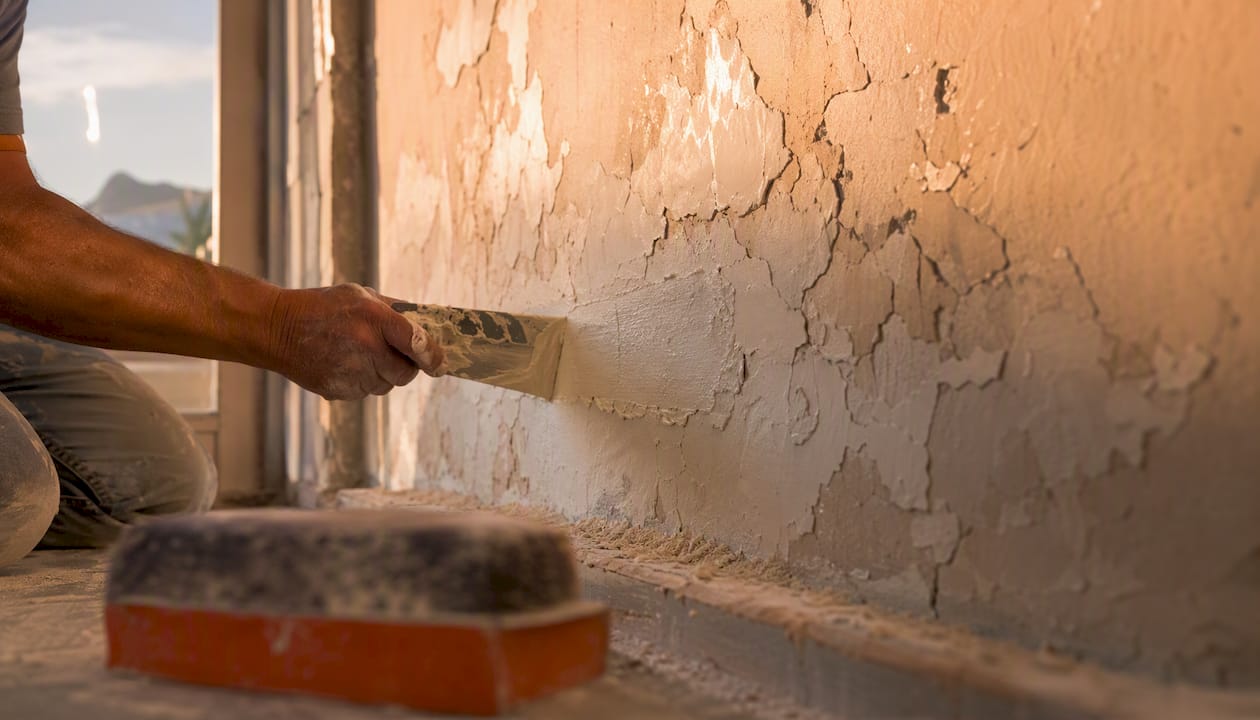
Number of coats and colour changes compound quickly. Two coats is the industry standard for a repaint. New plaster requires a sealer plus two finish coats. Changing from a dark colour to a light one often demands a third coat because the dark pigment bleeds through.
Paint system and durability affect price more on exteriors than interiors. A budget PVA on interior walls is acceptable in low-traffic rooms. On an exterior wall facing the Cape south-easter or the Highveld summer sun, a cheap acrylic will chalk and peel within two to three years. Specifying a quality elastomeric or textured coating costs more upfront but lasts two to three times longer.
Access and height are often the most surprising line item. A single-storey home with clear perimeter access needs only ladders. A double-storey, a steep roof, or a narrow side passage may require scaffolding or a boom lift, which adds R3,000–R10,000 or more to the project and should appear as a separate line in any honest quote.
Climate and location add a specification layer that directly affects cost. Coastal properties near Cape Town or Durban need marine-grade primers and mould-resistant topcoats. Humid KZN climates require fungicidal additives in the paint system. Highveld properties need UV-stable coatings to handle intense summer radiation. These are not optional upgrades; skipping them means repainting in half the time.
Warning: A quote that looks 20–30% cheaper than the others usually reflects omitted prep, no primer, or a single coat where two are needed. The saving evaporates when the paint fails in 18 months.
What a professional quote must include
A quote that lists only “painting — 3 bedrooms — R15,000” is not a quote. It is a number with no scope, and it will cause disputes. Before signing anything, confirm the quote contains every item below.
- Measured paintable area in m² per room and surface type (walls, ceilings, exterior)
- Paint brand, product name, and product code for each surface (e.g., Plascon Double Velvet, Dulux Weathershield)
- Number of coats per surface, including primer or sealer where applicable
- Surface preparation steps listed explicitly: washing, sanding, crack filling, damp treatment, plaster repairs
- Access and equipment charges as a separate line (scaffolding, boom lift, ladder hire)
- Waste disposal and site clean-up included or excluded
- Start date and estimated completion date
- Workmanship warranty period (a reasonable guarantee covers defects in application for one to two years)
- Proof of insurance or certificate of insurance (COI) confirming public liability cover
- Labour vs supply-and-apply split if you are supplying your own paint
On the labour-vs-supply question: some painters quote labour-only and expect you to buy paint. Others quote supply-and-apply. Neither is wrong, but you must compare quotes on the same basis. Convert every quote to a total R/m² figure (labour + materials) before ranking them.
How to compare quotes and what red flags to watch for
Getting three quotes is the minimum. Getting them to mean something requires asking the same questions of each painter.
Questions to ask every painter:
- “Is primer or sealer included, and which product?”
- “How many coats does your quote cover, and what is the product code?”
- “Is scaffolding or access equipment included, or is that extra?”
- “Can you provide a line-item breakdown by room and surface?”
- “What surface preparation is included before the first coat?”
- “Do you carry public liability insurance, and can you provide the COI?”
- “What is your workmanship warranty, and is it in writing?”
Red flags that should prompt follow-up or rejection:
- A per-m² rate well below the national benchmark (under R50/m² all-in for interior) with no explanation
- Vague scope descriptions (“full paint job,” “two coats where needed”)
- No written timeline or start date
- No mention of surface preparation
- Reluctance to provide a COI or proof of registration
- A request for more than 30–40% upfront before work begins
Comparison tip: once you have three quotes, divide each total by the paintable m² you measured. That converts every quote to a comparable R/m² figure. A quote that looks cheaper in total may cover fewer square metres or fewer coats. The per-m² normalisation method is the most reliable way to compare like-for-like.
How long will your painting project take?
Timeline expectations matter as much as cost. A crew that rushes drying time between coats to finish faster is cutting corners, not being efficient.
- Single bedroom: 1–2 days for a two-person team (walls and ceiling, two coats, standard prep).
- Full 3-bedroom interior: 3–5 working days for a team of three, assuming sound plaster and no major repairs.
- Full interior + exterior repaint: 7–14 working days depending on team size, access complexity, and weather.
- Roof only (IBR or tile, single-storey): 1–3 days for a two-person team with appropriate access equipment.
What extends the schedule? Repair work is the most common cause of delays: crack filling, damp treatment, and replastering all need curing time before paint goes on. Exterior jobs are weather-dependent; painting onto a wet or damp surface causes blistering and early failure. Each coat needs adequate drying time before the next, typically four to six hours for water-based systems in good conditions.
Scheduling tip: ask your contractor to provide a day-by-day plan listing which rooms or surfaces are being worked on each day, when coats are applied, and when inspections happen. A painter who cannot produce this is unlikely to manage the job systematically.
Where to save and where not to skimp
Smart budgeting on a painting project is less about finding the cheapest painter and more about knowing which costs are fixed and which are genuinely flexible.
Sensible savings:
- Reduce scope rather than quality: paint three rooms now and two later instead of cutting the paint spec across all five
- Choose a mid-range product (Plascon Nurture, Dulux Easycare) over premium for low-traffic rooms like guest bedrooms
- Bundle interior and exterior work in one project to reduce mobilisation costs and scaffolding hire
- Agree on colours before the crew arrives; mid-project colour changes cost time and sometimes extra coats
- Accept a standard sheen (satin or eggshell) where a high-gloss finish is not functionally necessary
Where not to cut:
- Surface preparation is not optional. Skipping crack filling or damp treatment guarantees early failure
- Do not use no-brand exterior paint on coastal or high-UV sites. The cost difference per litre is small; the lifespan difference is not
- Do not skip primer on new plaster or bare surfaces. A sealer coat is what makes the finish coat adhere and last
Hidden damp, failed plaster behind a painted surface, or rusted fascia boards only become visible once prep begins. A contingency avoids the uncomfortable mid-project conversation about extra costs.
Why preparation and local climate matter more than most homeowners realise
The most expensive painting mistake in South Africa is not choosing the wrong colour. It is painting over a problem that was never diagnosed.
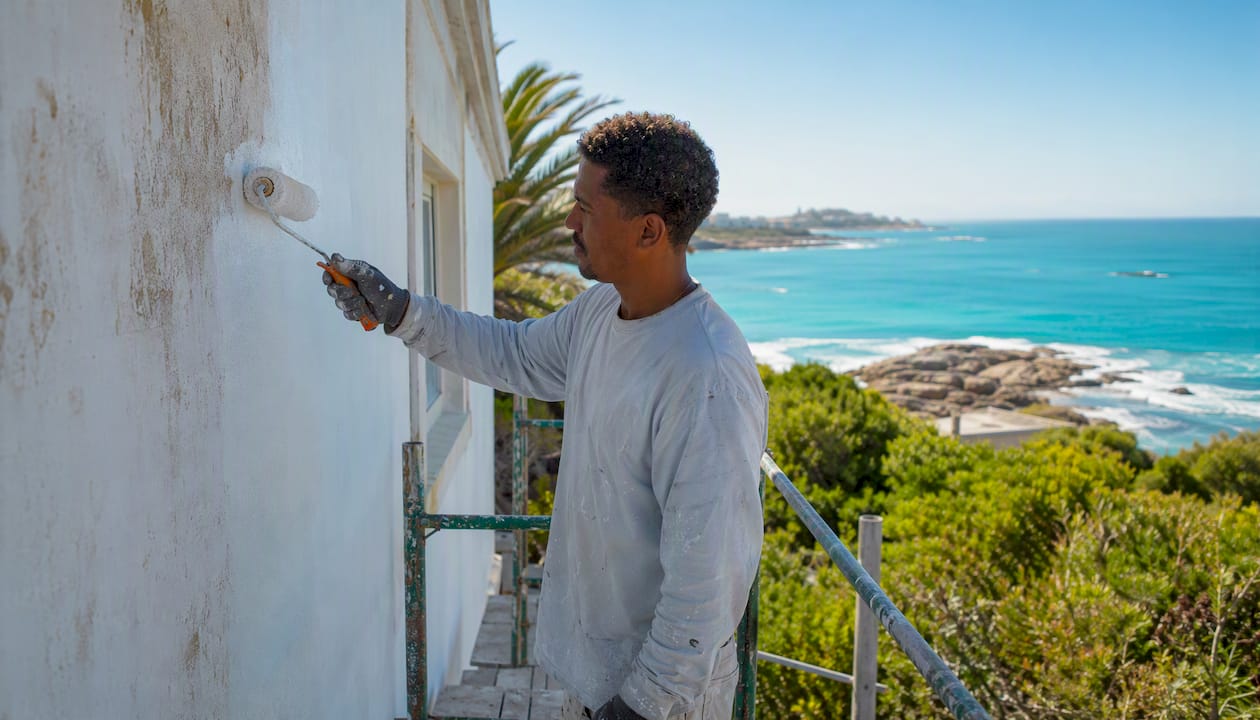
A diagnostic surface assessment before quoting is standard practice for experienced painters in Cape climate zones, where hidden damp or substrate failure commonly changes the scope and cost of a job. A wall that looks sound may have rising damp behind the plaster, a failed waterproof membrane, or salt crystallisation from coastal exposure. Painting over any of these without treatment means the new coat fails within months.
Climate-specific specification adjustments:
- Cape Town and coastal Western Cape: marine-grade primers, mould-resistant topcoats, and salt-resistant sealers. Coastal jobs typically attract a 10–25% premium for these specification upgrades
- Durban and humid KZN zones: fungicidal additives in the paint system and breathable coatings that allow moisture vapour to escape without blistering
- Highveld (Gauteng, Mpumalanga): UV-stable topcoats that resist the intense summer radiation and wide daily temperature swings
- Eastern Cape and interior towns: generally lower labour rates but the same prep requirements; do not let a lower rate tempt you into skipping specification
Pro Tip: Request an in-person inspection before accepting any quote for a Cape coastal property. A painter who quotes from photos or floor plans cannot assess substrate condition, existing damp, or access constraints accurately. The inspection costs nothing and prevents scope disputes later.
Capeapexpainters conducts a diagnostic site assessment before every quote in Cape Town, the Cape Winelands, and the Overberg, to catch these issues before they become mid-project surprises.
What the painters see that homeowners miss
Most homeowners focus on colour and finish. The painters who produce durable results focus on what is underneath.
The most common pattern on a first site visit: a homeowner points to peeling paint on an exterior wall and asks for a repaint. The real problem is a cracked sill above the window letting water in behind the plaster. Repaint without fixing the sill and the new coat peels in the same spot within a year. Fix the sill first, treat the damp, allow it to dry, then prime and paint. That sequence costs more upfront and takes longer, but the result lasts five to eight years instead of one.
What you can do before the crew arrives to save time and money:
- Clear furniture away from walls and remove pictures and fittings
- Fix any active leaks (roof, plumbing, windows) before the painting crew arrives
- Agree on your colour palette and order samples at least two weeks before the start date
- Flag any known damp patches, cracks, or areas of previous repair so the team can assess them on day one
Capeapexpainters: preparation-first painting in Cape Town and beyond
Skipping surface prep is the most expensive shortcut in residential painting. Capeapexpainters takes the opposite approach: every project in Cape Town, the Cape Winelands, and the Overberg starts with a diagnostic site assessment that identifies damp, failed plaster, and substrate issues before a quote is issued.

The team is fully in-house, not subcontracted, which means the same painters who assess your property apply the coatings. Specifications are matched to the Cape climate: marine-grade primers for coastal homes, fungicidal systems where mould is a risk, and UV-stable topcoats for high-exposure facades. Every quote includes the paint brand and product code, the number of coats, preparation steps, and a written workmanship guarantee.
If you want an itemised quote you can actually compare, request a site inspection from Capeapexpainters and get a scope-specific price based on your property’s actual condition.
Sources
The benchmarks in this guide draw from the following South African pricing references. Use them to cross-check regional variations or verify specific product and labour rates for your area.
- How Much Does It Cost to Paint a House in South Africa? Latest Prices Revealed | ServiceLink SA
- House Painting Cost in South Africa: 2026 Pricing Guide | Fonster
- Plastering & Painting Cost Guide South Africa 2026
- Painting Cost Per m² – Prep, Coverage and Quote Scope
- How Much Does It Cost To Paint A House In South Africa? – Simon Painting Pty Ltd
To check whether a quote reflects your specific region, compare the labour-only rate against the provincial benchmarks in the SA Property Tools and ServiceLink SA guides, then adjust for coastal or climate-specific specification requirements.