

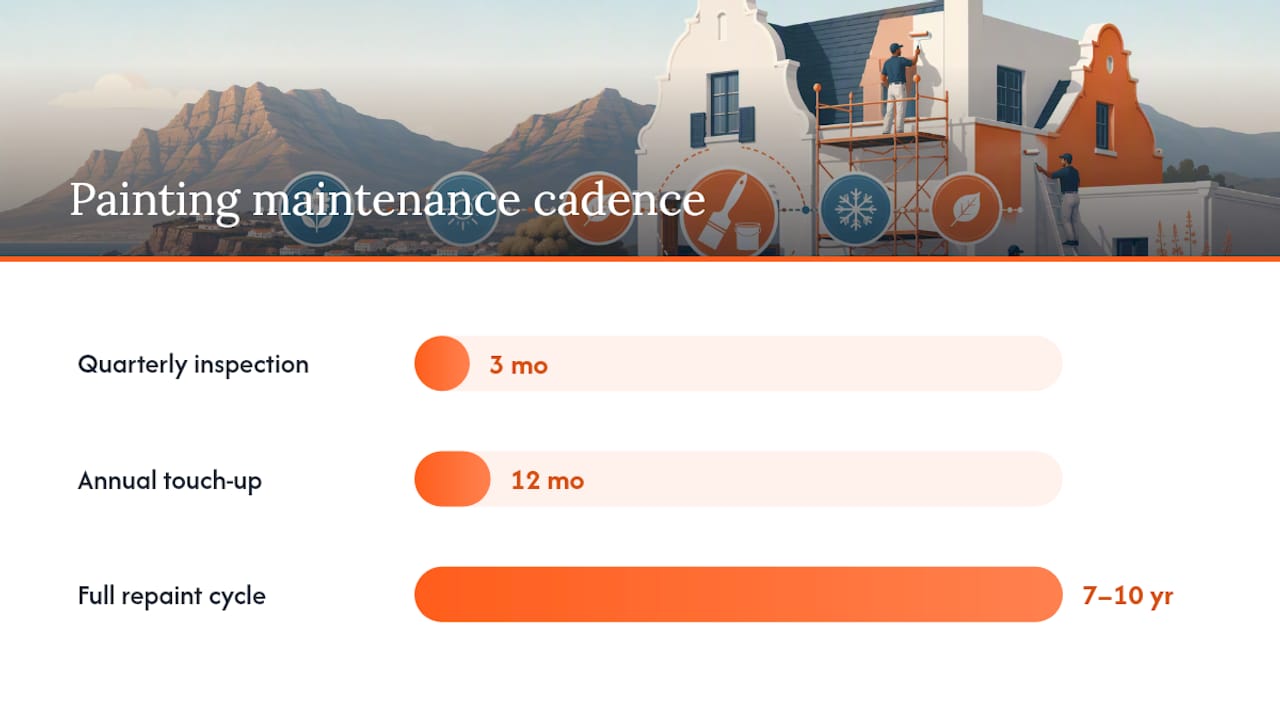
The right cadence is simple: quarterly visual inspections, an annual touch-up window, and a full repaint every 7 to 10 years depending on exposure and coat system. Every specification you sign should lock down four things: the coat system (primer, sealer, finish coats), documented surface prep, a stated access method, and photographic records tied to each visit. If your estate has gone more than a year without a documented walkthrough, the next move is straightforward.
Commission an on-site diagnostic and a written specification from a qualified maintenance painter, Cape Apex Painters being a direct local option, before the next AGM. That single step converts vague budget line items into numbers trustees can defend.
- Quarterly: visual inspection, defect log, photos
- Annually: touch-up window during dry months
- Every 7-10 years: full repaint cycle with new coat system
- Always: written specification with prep standards and access method attached
Table of Contents
- The phased estate painting maintenance plan trustees actually need
- What should a quarterly painting inspection cover?
- What must a painting specification include for tenders?
- How does paint quality change coating lifespan on the coast?
- What does painting cost per square metre in the Western Cape?
- How should trustees tender a maintenance painting contract?
- What does a preparation-first process look like on-site?
- What environmental factors should guide paint selection and disposal?
- What health and safety rules apply to estate painting work?
- Why does exterior colour fade faster in the Western Cape?
- How does the Cape climate affect paint beyond seasonal timing?
- How does painting fit into overall estate facilities management?
- What trustees usually get wrong about painting maintenance
- Get a written maintenance specification for your estate
- Sources
The phased estate painting maintenance plan trustees actually need
Most bodies corporate treat painting as a single catastrophic expense that surfaces every decade. That’s backwards. A phased plan spreads cost, catches damage while it’s still cheap, and gives trustees a paper trail when owners ask where the levy went.
Break the cycle into three tiers, each with its own trigger and budget logic.
- Every 90 days. A trustee or managing agent walks the perimeter with a phone camera. Look for hairline cracks widening, caulk pulling away from window frames, and any patch where paint has started chalking or lifting at the edges. This costs nothing but time and catches problems before water gets behind the substrate.
- Annually, in one dedicated window. Bundle every minor defect flagged during the quarterly walks into a single touch-up contract, ideally scheduled for the dry season. Painting one wall at a time as complaints arrive is the most expensive way to maintain an estate. Batching labour and access costs into one visit a year cuts the per-defect cost significantly.
- Every 7 to 10 years. A full repaint cycle, not a touch-up. This is when you replace the entire coat system rather than patching over it, and when scaffold or boom-lift costs get spread across the whole building rather than one balcony.
Tag every defect found during inspection with one of three labels: now (active water ingress, structural cracking, safety hazard on access routes), soon (cosmetic peeling, minor efflorescence, isolated mildew), or budget (items to fold into next year’s touch-up cycle rather than an emergency callout). This tagging system is what turns a maintenance plan from a wish list into something a finance committee can actually approve.
The financial logic here isn’t complicated: preventive, scheduled maintenance, quarterly walkthroughs plus one annual touch-up day, costs considerably less over five years than reactive repainting triggered by tenant complaints, because small defects caught early never get the chance to rot the substrate underneath.
What should a quarterly painting inspection cover?
A quarterly inspection only works if it’s repeatable. If two different trustees produce two different reports, you have no baseline to compare against, and no way to prove deterioration to a contractor disputing a warranty claim.
Walk the building with a fixed checklist every time, not a mental list that changes based on who’s holding the clipboard.
- Caulk joints around windows, doors and expansion joints, checking for separation or shrinkage
- Efflorescence (white powdery salt deposits) on plastered or painted surfaces, especially near ground level or downpipes
- Peeling, blistering or chalking on sun-facing elevations
- Water stains or discoloration below gutters, window sills and roof junctions
- Mildew or algae growth, particularly on south-facing or shaded walls
- Substrate movement: new cracks, widening existing cracks, or bulging plaster
Score each item on a simple three-point scale so non-specialists can use it consistently: 0 for no issue, 1 for cosmetic and monitor, 2 for active deterioration requiring a contractor quote within 30 days. Anything scoring a 2 on a structural item, bulging plaster or a crack that’s grown since the last inspection, should trigger a call to a contractor immediately rather than waiting for the next quarterly cycle.
Keep the record format minimal so it actually gets filled in every quarter:
| Field | What to capture |
|---|---|
| Location | Building/unit number and elevation (north, south, east, west) |
| Defect type | One of the six checklist categories above |
| Score | 0, 1 or 2 |
| Photo reference | File name matching location and date |
| Action | Monitor, schedule for annual touch-up, or escalate now |
Label photos consistently, something like “BlockC_Southwall_2026Q1_crack01.jpg”, so five years of records are searchable rather than a folder of unlabelled images nobody can match to a defect. That habit alone saves hours when you’re compiling a tender packet or defending a warranty claim years later.
What must a painting specification include for tenders?
A specification is not the same as a quote. A quote tells you the price. A specification tells you exactly what you’re paying for, and it’s the document that protects trustees when a contractor’s work fails early.
Require these prep standards as non-negotiable line items, not vague promises:
- Pressure washing of all exterior surfaces before any coating is applied
- Fungicidal wash on any surface showing mildew or algae growth
- Crack repair using a flexible filler rated for the substrate, not just a skim coat
- Plaster restoration on any area showing bulging, hollow-sounding, or delaminated render
- Damp treatment addressed and signed off before painting proceeds, never painted over
- Alkali-resistant primer on new or previously bare plaster, sealer coat where the substrate demands it
The coat system itself needs to be named, not described. “Two coats of exterior paint” tells you nothing. A proper specification states primer, sealer where applicable, and the number and type of finish coats, plus the specific product line and colour or batch code. Without batch codes, a touch-up done eighteen months later can visibly mismatch the original coat, and you have no record to hold either contractor accountable.
On pricing, insist the quote breaks out prep, labour, materials and scaffold or boom-lift access as separate line items rather than one lump sum. A professional painting quote should state total wall area in square metres, coat counts, product brand, and surface-prep steps explicitly, and silent prep is where most disputes with contractors begin. Warranty terms and a defined snag-resolution period, typically 12 to 24 months depending on the coat system, should be written into the contract, not left as a verbal assurance.
Pro Tip: Ask every bidding contractor to quote using the same wall-area figure you provide, not their own measurement. It’s the fastest way to spot a bid that’s cutting corners on prep before you’ve even seen the work.
How does paint quality change coating lifespan on the coast?
Coastal salt air, UV load and winter rain put more stress on a coat system than almost any inland climate in the country. That means the cheapest tin of paint on the shelf is rarely the cheapest option once you calculate cost per year of coating life rather than cost per litre.
Three tiers roughly map to three outcomes:
- Budget systems hold up for 3 to 5 years on a sun-facing coastal elevation before visible chalking or fading sets in, often needing an extra coat just to achieve even coverage.
- Standard mid-range systems typically deliver 5 to 7 years of solid performance and are the reasonable default for most estate common areas.
- Premium systems, with better UV and salt resistance, commonly stretch coating life toward the 8 to 10 year mark and often need fewer coats to achieve full opacity, partly offsetting the higher tin price.
Premium paint typically costs R150 to R300 more per five-litre tin than budget alternatives, but if it buys you two or three extra years before the next full repaint cycle, the maths usually favours the higher spec once you account for scaffold and labour costs you avoid repeating.
For balconies, retaining walls, or any surface with a history of water ingress, an elastomeric or waterproofing-rated system is worth specifying outright rather than defaulting to standard exterior paint. These systems bridge hairline cracks and resist wind-driven rain in a way ordinary acrylic coatings cannot.
Darker colours also fade faster under Cape sun and absorb more heat, which can affect coat count and cure behaviour, so a colour change during a repaint cycle sometimes needs an extra coat purely to achieve consistent coverage over the previous shade.
What does painting cost per square metre in the Western Cape?
Budgeting an estate repaint starts with getting the area right. Interior labour typically runs R25 to R60 per square metre of paintable wall area, and exterior labour commonly runs R35 to R80 per square metre depending on access difficulty and how much prep the walls need. Cape Town rates tend to sit toward the upper end of those national ranges, particularly for experienced teams rather than apprentice crews.
The area itself is where many quotes go wrong. Contractors quoting off floor area rather than paintable wall area routinely under-scope a job, since a standard room with 2.7 metre ceilings has considerably more paintable wall area than its floor plan suggests.
| Project scale | Typical total cost range |
|---|---|
| 3 bedroom house, full interior repaint | costs vary depending on preparation, materials, and labour |
| Large estate home, interior and exterior | costs vary widely depending on preparation, materials, and site access |
Scaffold or boom-lift hire should always appear as its own line item, never folded into the labour rate, so trustees can compare access costs across bidders independently of workmanship pricing.
On timing, the Western Cape’s dry season, roughly September through May, is the recommended window for exterior work because paint needs dry conditions and temperatures above 10°C to cure properly. Painting over damp walls during the winter rains is one of the most common causes of early coating failure on Cape estates. Any contract you sign should include a cure-condition clause allowing the contractor to pause work if temperature or humidity falls outside the product manufacturer’s stated range.
How should trustees tender a maintenance painting contract?
An estate that tenders painting work the same way every three years, lowest quote wins, keeps re-learning the same lesson: cheap bids usually skip prep, and skipped prep means an early repaint. A structured tender process fixes that.
- Request a complete tender packet from every bidder: a written specification (not just a price), proof of insurance and safety certification, evidence of an in-house team rather than rotating subcontractors, and a sample coat system with product names.
- Score bids against a fixed matrix, not gut feel: specification compliance, quality of photographic documentation offered, warranty length, and price transparency (itemised versus lump sum) should each carry defined weight.
- Structure payment in milestones rather than a single deposit and final payment. A 30 to 50% deposit for large jobs is standard practice, with progress payments tied to completed phases reducing the estate’s exposure if a contractor underperforms mid-project.
- Withhold a retention amount, typically 5 to 10% of contract value, released only after the snag list from final inspection has been resolved.
Pro Tip: Never accept a verbal assurance that “prep will be done properly.” Require prep steps to be itemised and priced separately in the tender, so a contractor can’t quietly skip fungicidal washing or crack repair to undercut a competitor’s price.
Requiring an in-house team over subcontracted labour isn’t just a quality preference. It’s an accountability mechanism: when the same crew does the diagnostic, the prep and the finish coats, there’s one point of responsibility if something fails within the warranty period.
What does a preparation-first process look like on-site?
The gap between a coating that lasts five years and one that lasts ten almost never comes down to the paint itself. It comes down to what happens before the first coat goes on, and that’s the part cut-price bids skip.
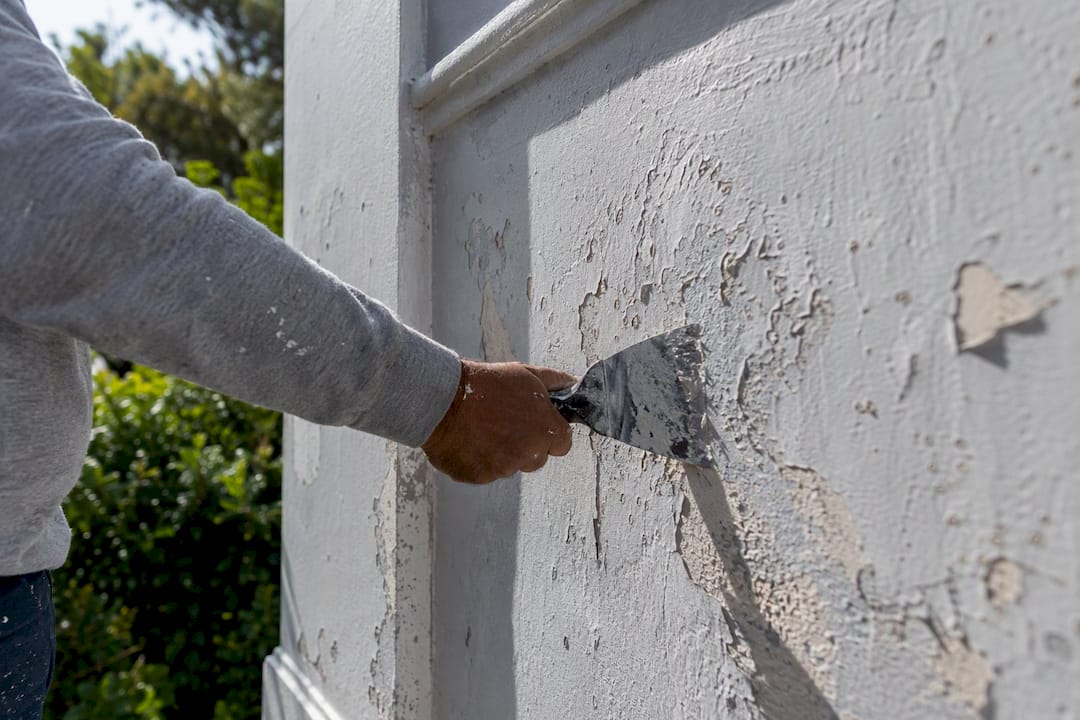
Cape Apex Painters operates with full-time, in-house teams across Cape Town, the Cape Winelands and the Overberg, rather than rotating subcontractors, which matters on estate work because the crew that diagnoses the damp problem is the same crew accountable for the finish coat months later. Their process is built around addressing damp and old paint failures before any new coating goes down, with damp-proofing built in as a specialised capability rather than an afterthought.
A preparation-first sequence a trustee should expect to see written into a specification looks like this:
- On-site diagnostic identifying damp sources, substrate condition and existing coating failures
- Pressure wash and fungicidal treatment where mildew or algae is present
- Crack repair and plaster restoration on any compromised sections
- Damp treatment completed and signed off before any coating proceeds
- Alkali-resistant primer and sealer coat matched to substrate condition
- Finish coat system applied per the agreed specification, colour and batch code recorded
Maintenance contracts should require a paint record handed back after every visit, colour codes, product line, batch numbers, applicator name and date, because that record is what prevents an expensive mismatch or scope-padding dispute the next time someone touches that wall.
Ask for photographs at each stage, not just before-and-after shots of the finished wall, plus a signed scope document confirming what was actually done against what was quoted.
What environmental factors should guide paint selection and disposal?
Paint choice on an estate isn’t only about coating life. Low-VOC (volatile organic compound) formulations have become the standard specification for occupied buildings, reducing off-gassing during application and cure, which matters when residents are living on-site while work happens around them.
Water-based acrylic systems have largely replaced solvent-based paints for most exterior estate work in the Western Cape, partly for lower environmental impact and partly because they’re easier to apply safely in occupied common areas without extended ventilation periods.
Disposal is where estates often fall short without realising it. Leftover paint, empty tins and contaminated wash water cannot simply go into general municipal waste or down a stormwater drain. Most municipalities in the Western Cape require paint waste to go through a registered hazardous waste handler or a paint recycling drop-off point, and a responsible contractor should account for correct disposal in their method statement, not leave tins and offcuts for the body corporate to deal with after the job.
Specify in your tender that the contractor is responsible for removing and correctly disposing of all paint waste, empty containers and contaminated materials generated on-site. This is a small line item to write into a contract and a significant liability to leave unaddressed, since improper disposal of paint waste can expose the body corporate to environmental compliance issues under local municipal by-laws.
Where an estate is repainting a large surface area, ask the contractor which product lines carry recognised environmental certification, since that information should already be part of their standard specification documentation rather than something trustees have to chase down separately.
What health and safety rules apply to estate painting work?
Painting work at height on an estate falls squarely under South Africa’s Occupational Health and Safety Act, and any contractor working on scaffolding, boom lifts or ladders above a certain height must carry valid fall-protection training and equipment for every worker on-site, not just a supervisor.
Trustees should require proof of a valid safety file before work begins, not after an incident. This includes risk assessments specific to the site (proximity to walkways, parking, playgrounds or pool areas), method statements for working at height, and public liability insurance that names the body corporate as an interested party where the estate’s own insurer requires it.
Scaffolding erected on shared property needs to be signed off by a competent person before use, and access routes for residents must remain clearly demarcated and barricaded during work. This matters more on an estate than a single residential job, because a body corporate carries liability exposure to residents and visitors that an individual homeowner doesn’t face in the same way.
Ask for the contractor’s safety documentation as a standard tender requirement alongside the technical specification, not as an afterthought once a contract is already signed. A contractor unwilling to produce this paperwork upfront is telling you something about how they’ll handle the rest of the job too.
Chemical safety data sheets for any fungicidal wash, primer or paint containing hazardous components should also be available on request, particularly relevant where painting happens near communal pool areas, play equipment or vegetable gardens on the estate grounds.
Why does exterior colour fade faster in the Western Cape?
UV intensity along the Western Cape coastline is high for most of the year, and it’s the single biggest driver of colour fade on exterior surfaces, well ahead of rain or salt air individually.
Darker pigments absorb more UV energy and heat, which accelerates the breakdown of the paint’s binder over time. A deep charcoal or navy exterior will typically show visible fading years before a lighter, more reflective colour on the same elevation, sun exposure being equal. This is worth raising with trustees before a colour change is approved purely on aesthetic preference, since a darker palette may quietly shorten the repaint cycle you’ve budgeted for.
North-facing and west-facing walls, catching the most direct afternoon sun, fade noticeably faster than south-facing or shaded elevations on the same building. That’s a genuinely useful thing to note in your inspection records: if one elevation is chalking or fading years ahead of the others, it’s a normal function of orientation, not necessarily a sign the paint job itself was substandard.
Pigment quality varies significantly between budget and premium paint lines, and this is one of the clearest places where spending more upfront pays off directly in visual outcome. Premium exterior paints use more UV-stable pigments and binders specifically formulated to resist chalking, which is why two houses painted the same colour can look years apart in condition after the same five-year period.
Keep a colour and batch record from every repaint cycle. When only one section needs touch-up work between full repaints, matching the original pigment batch is the difference between an invisible repair and a visible patch.
How does the Cape climate affect paint beyond seasonal timing?
Scheduling around the dry season solves the cure-condition problem, but the Cape climate does ongoing damage to a coat system in ways that have nothing to do with when the paint was applied.
Coastal salt air is corrosive to certain substrates and can accelerate the breakdown of paint film on properties within a few kilometres of the coastline, particularly on surfaces facing prevailing onshore winds. Estates in Camps Bay, Simon’s Town or along the Overberg coast typically need shorter repaint cycles than an equivalent property in a Winelands valley, purely because of salt exposure, even when both were painted with identical products.
The Cape’s wind patterns matter too. Strong, sustained wind, particularly the southeaster in summer, drives rain and airborne salt horizontally onto walls that would otherwise be relatively sheltered, and it accelerates the drying of paint during application in a way that can affect film formation if the contractor doesn’t adjust technique accordingly.
Temperature swings between hot, dry summer days and cold winter nights cause repeated expansion and contraction in both the substrate and the coating, which is a major contributor to hairline cracking over time, independent of UV exposure or rain. Buildings on the Cape Flats, with sandy, potentially unstable substrate, can also experience more structural movement than properties on more stable ground, which shows up first as cracking in the paint film before it’s visible anywhere else.
None of this means the Western Cape is a uniquely hostile place to maintain a painted building. It means the inspection and maintenance cadence needs to account for microclimate, not just calendar timing, and that a coastal estate and a Winelands estate shouldn’t necessarily be on identical repaint schedules even if they were built the same year.
How does painting fit into overall estate facilities management?
Painting maintenance shouldn’t sit in isolation from the rest of an estate’s facilities plan. Gutters, roofing, waterproofing and painting are all connected systems, and treating them as separate budget lines with separate schedules is how estates end up painting over problems that originate somewhere else entirely.
A blocked gutter that overflows onto a wall for two winters will cause staining and coating failure no amount of premium paint will fix permanently until the gutter itself is repaired. The same logic applies to roof flashing, downpipes and any structural waterproofing: a painting maintenance plan that isn’t cross-referenced against the roofing and drainage maintenance schedule is treating a symptom rather than the cause.
The most efficient estates fold their painting inspection into the same quarterly walkthrough used for general building maintenance, rather than running two separate inspection regimes with two separate contractors and two separate reporting formats. This isn’t just administratively simpler. It means a roofing defect that’s about to cause a paint failure gets caught before the wall is even repainted, saving a full cycle of wasted coating cost.
When budgeting the annual maintenance reserve, painting should be one line item within a broader building envelope maintenance category, alongside roofing, waterproofing and structural repairs, rather than its own isolated fund. This gives trustees a clearer picture of where deferred maintenance in one category is quietly driving up costs in another, and it makes long-term reserve fund planning considerably more accurate than treating painting as a standalone ten-year surprise.
An estate that maintains its coat system on a predictable cycle rarely needs an emergency repaint, and that predictability is the real value of a documented maintenance plan.
Every one of the frameworks in this article, the quarterly checklist, the specification language, the tender scoring matrix, works because it treats painting as an ongoing maintenance discipline rather than a one-off capital project.
| Point | Details |
|---|---|
| Set the cadence | Quarterly inspections, one annual touch-up window, and a full repaint every 7 to 10 years. |
| Quote by wall area | Insist bids use paintable wall area, not floor area, to avoid under-scoped contracts. |
| Demand a written specification | Require named coat systems, prep steps, batch codes and itemised scaffold pricing before signing. |
| Schedule around the dry season | Book exterior work between September and May when temperatures support proper paint cure. |
| Work with a preparation-first, in-house contractor | Cape Apex Painters uses full-time teams and damp-proofing expertise across the Western Cape for accountable, documented estate maintenance. |
What trustees usually get wrong about painting maintenance
The conventional advice on estate painting treats it as a procurement exercise: get three quotes, pick the middle one, sign a contract every decade. That approach consistently produces the worst outcomes I’ve seen described in cost and maintenance data, because it optimises for the wrong variable. Price per square metre means nothing if the prep was skipped and the coating fails in year four instead of year eight.
What gets underestimated is documentation. Trustees rotate every few years, but a painted building doesn’t reset its memory. Without batch codes, photographic records and a written specification history, every new committee starts from zero, re-diagnosing problems a previous contractor already solved and often paying to redo work that should have lasted another five years.
If there’s one thing to prioritise above coat systems, pricing benchmarks or scheduling windows, it’s this: build the paper trail before you build the paint job. A specification and a photographic record turn painting from a recurring emergency into a managed asset. Everything else in this plan supports that one habit.
— Thinus
Get a written maintenance specification for your estate
Most estates end up choosing between a low bid that skips prep or a vague verbal quote nobody can hold accountable months later. Cape Apex Painters gives Western Cape trustees a third option: a full-time, in-house team that diagnoses damp and coating failures before quoting a single coat, so the specification you take to your AGM is based on what your buildings actually need, not a generic per-square-metre guess.

Their preparation-first approach, pressure washing, fungicidal treatment, crack repair and damp-proofing before any primer goes down, is built specifically for coastal salt air, UV load and winter rain, the conditions that cause most estate repaints to fail early. Because the same crew handles diagnosis, prep and finish coats, there’s one point of accountability if a warranty issue comes up two years later, not a subcontractor who’s moved on.
If your estate hasn’t had a documented inspection in the past year, the next step is simple: request an on-site diagnostic and written specification through the Cape Apex Painters site before your next budget meeting.
Sources
Trustees compiling a tender packet or budget motion don’t need to build every reference from scratch. A few existing resources cover the technical and pricing detail an AGM finance committee will ask about.
- Plastering & Painting Cost Guide South Africa 2026
- House Painting Cost in South Africa: 2026 Pricing Guide | Fonster
- Painting Contractor Quote Template South Africa | House Painting Quotation | Plurgo