
Budget between R70 and R100 per square metre for standard commercial interior painting in South Africa, with specialist coatings like epoxy floors running R180 to R350 per m². Surface preparation, access equipment, and paint specification drive most of the variance between quotes. Before signing anything, request an itemised quote and confirm the contractor’s CIDB grading and B-BBEE status.
TL;DR:
- Surface condition, access requirements, and paint specifications are the main factors causing quote variances, with surface prep often accounting for most costs.
- Exterior painting costs R90 to R150 per m², with coastal areas requiring marine-grade or UV-stable coatings that push prices toward the top of that range.
- Epoxy floor coatings can cost R180 to R350 per m², especially if concrete repair or grinding is necessary beforehand.
- A detailed, itemized quote should specify measured area, number of coats, paint brand, preparation work, and separate access costs to avoid hidden expenses.
- Contingency budgets should include extra costs for after-hours work, specialist coatings, structural repairs, and height access equipment, which can significantly increase project totals.
Table of Contents
- How much does commercial painting cost in South Africa?
- What drives the price difference between quotes?
- What does a real commercial painting project actually cost?
- How do you get an accurate quote for commercial painting?
- What extra costs should you budget for?
- How Cape Apex Painters approaches commercial jobs in the Western Cape
- What most facility managers get wrong about painting procurement
- Ready to get an itemised commercial painting quote?
- Where to verify pricing, standards, and compliance
- Sources
How much does commercial painting cost in South Africa?
Pricing splits into three rough tiers, and knowing which one your project falls into saves you from comparing apples to industrial-grade oranges.
Standard commercial wall painting, meaning labour and materials combined, typically costs within a moderate range per square metre. That’s the number to use when budgeting a straightforward interior repaint of an office, retail unit, or reception area with normal wall heights and no major surface defects. Some regional guides quote a wider band of R40 to R120 per m² depending on the finish level and location, and one commonly cited average for interior commercial work sits around R81 per m² for a standard job.
Exterior work usually costs more than interior work per square metre, because it involves height, weather exposure, and often more surface prep. Expect exterior commercial walls to sit somewhere between R90 and R150 per m² once you factor in scaffolding access and UV-resistant coatings. Coastal buildings in areas like Camps Bay, Simon’s Town, or the Strand push toward the top of that range, since salt air corrodes standard coatings faster and specifying marine-grade or UV-stable formulations is often the more sensible long-term option.
Specialist coatings sit in a different category entirely:
- Epoxy floor coatings for warehouses and industrial floors: R180 to R350 per m², depending on the number of coats and whether the concrete needs grinding or repair first; see our detailed comparison of warehouse flooring options for more information.
- Anti-graffiti coatings, used on retail frontages and public-facing walls: priced at a premium over standard exterior paint because they require a clear, sacrificial or permanent barrier system.
- Anti-corrosion coatings for steel structures, railings, and roof sheeting: priced per m² but heavily influenced by the amount of rust remediation needed before the coating goes on.
Complex access work changes the equation again. When a job requires rope access, boom lifts, or confined-space entry, contractors often quote by the hour or day rather than per m². Hourly labour rates for that kind of complex application commonly run R450 to R900 per hour, which explains why a small area of high-level steelwork can cost more than a much larger flat wall job.
One caveat worth repeating: these are indicative ranges pulled from market pricing guides, not a quote for your specific building. Your final number depends heavily on what’s underneath the old paint, which is exactly what the next section covers.
What drives the price difference between quotes?
Two contractors can look at the same building and come back with quotes R30 per m² apart, and it’s rarely because one is padding their margin. It’s almost always down to three things: what condition the surface is actually in, what it takes to reach it safely, and what’s being specified to go on top of it.
1. Surface condition and preparation
This is where budgets go sideways if it’s skipped. Damp-proofing, grit blasting, rust treatment, and concrete repair all cost money before a single litre of paint gets opened. A wall with rising damp needs the moisture source diagnosed and treated, not just a damp-sealing primer slapped over a symptom. Steel that’s already rusting needs mechanical treatment or chemical rust converters before any protective coating will hold. Contractors commonly point out that most of a paint job’s lasting performance comes down to how well the surface was prepared, not which brand of paint went on last. Skip that step and you’re financing a repaint in two years instead of eight.
2. Access and safety equipment
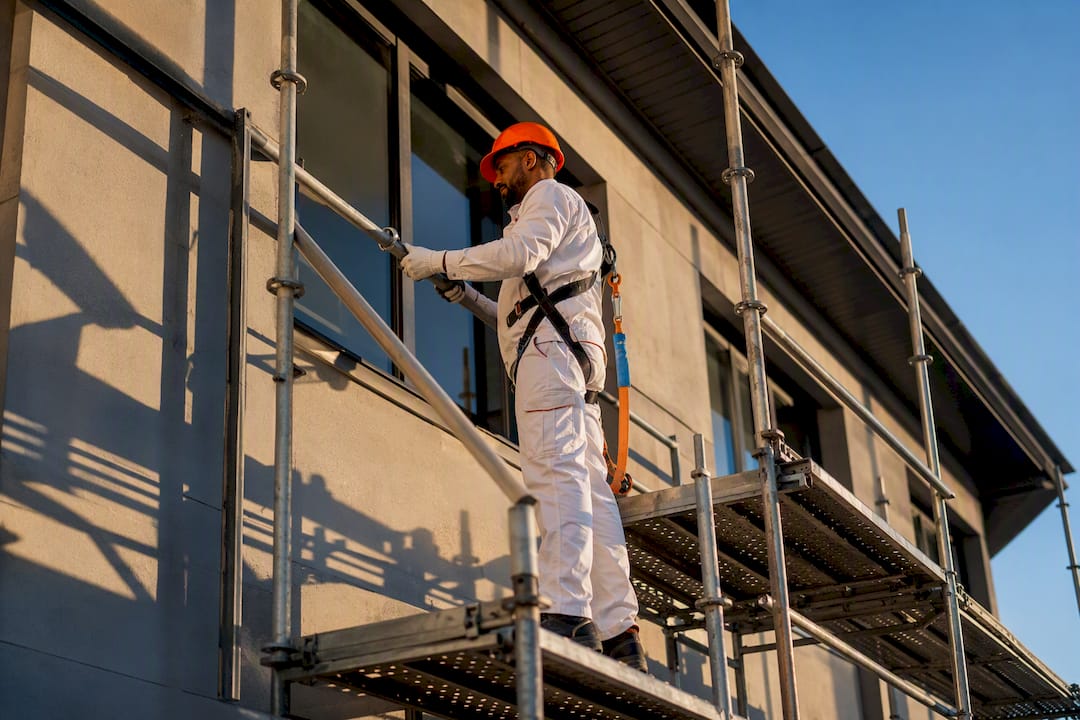
Scaffolding, boom lifts, and harness systems aren’t optional line items for anything above ground floor. A two-storey office block with parapet walls needs scaffold hire, which adds both a rental cost and labour time to erect and strike it. Industrial sites often require OHS-compliant method statements, fall-arrest documentation, and site inductions before any contractor’s team can even start, particularly on retail centres or corporate campuses with their own safety officers. If a quote doesn’t mention access equipment at all for a building over one storey, that’s a gap, not a saving.
3. Paint specification and number of coats
Grade matters more than most property owners assume. A budget acrylic might cost half the price of a premium exterior formulation, but it can fail in UV exposure within three or four years along the Cape coastline, versus eight to ten years for a properly specified marine-grade product. The number of coats also matters. Two coats over a properly primed, prepared surface is the industry norm for most commercial work. One coat over old paint is a false economy that shows through within a season, and it’s exactly what tight, unrealistic quotes tend to skip.
Pro Tip: If a quote looks unusually low, check what it says about preparation. A one-line item like “surface prep” with no detail on damp treatment, patching, or sanding usually means it’s not budgeted properly, and you’ll be asked for a variation order once the painters uncover the real condition of the walls.
Here’s a simple way to read any quote you receive:
- Check the prep line first. Does it name the actual work (grit blasting, damp treatment, filler and sand) or just say “prepare surface”?
- Check access costs are itemised separately. Scaffolding and lift hire should never be folded silently into a per-m² rate.
- Check the paint brand and product code, not just “premium paint.” SABS-referenced or SANS-compliant products give you something to hold the contractor to.
- Check the number of coats stated in writing, not verbally promised.
What does a real commercial painting project actually cost?
Numbers on a page mean more once they’re attached to a building you can picture. Here are three worked examples using the per-m² bands above, with the assumptions spelled out so you can adjust them for your own site.
150m² retail shop, interior repaint. At R70 to R100 per m² for standard walls, the core painting cost lands between R10,500 and R15,000. Add basic prep (filling, sanding, one coat of stain-blocking primer) and you’re looking at a realistic total of R13,000 to R18,000, assuming no damp issues and reasonable ceiling height with no scaffold needed.
500m² office floor, interior and light exterior signage wall. Interior at the same R70 to R100 per m² band gives R35,000 to R50,000 for the bulk of the space. If the project includes an exterior feature wall needing scaffold access, add roughly R8,000 to R15,000 for equipment hire and the higher exterior rate on that section. A realistic total sits around R45,000 to R68,000, depending on how much of the office needs colour changes versus a straight repaint of existing tones.
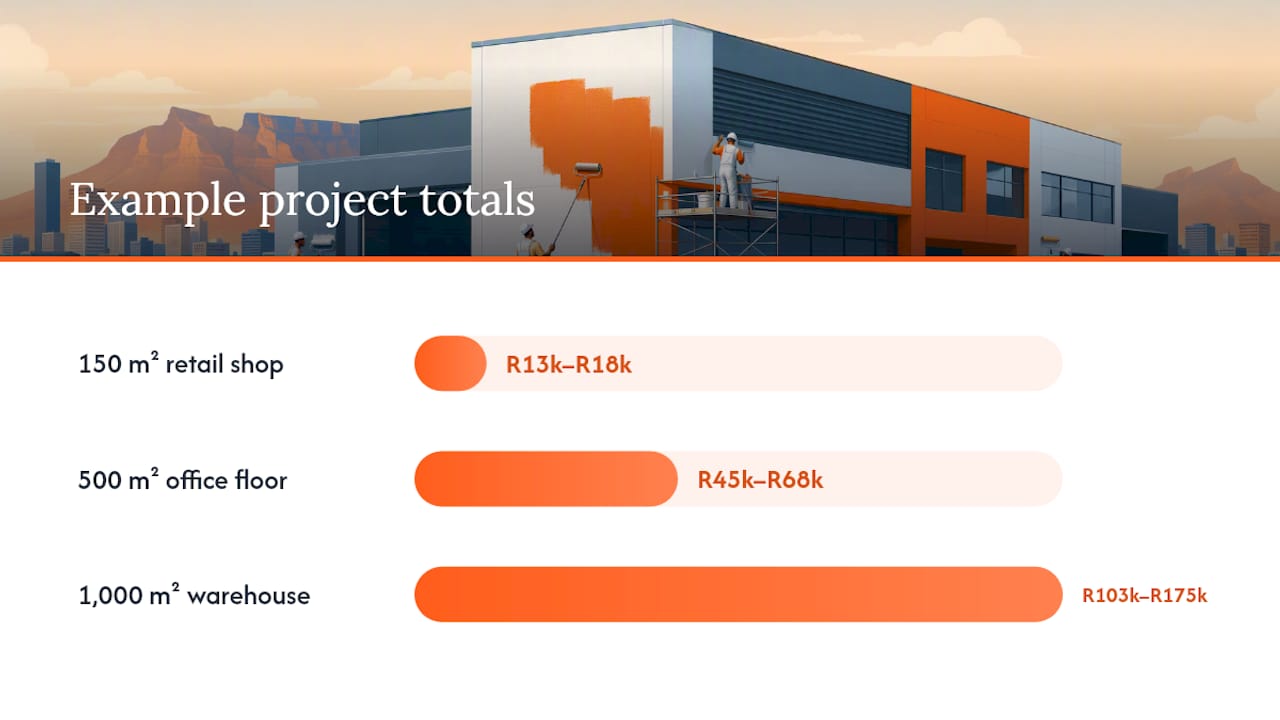
1,000m² warehouse, including epoxy floor coating on 300m² and wall repainting on the remainder. The 700m² of standard wall and ceiling painting at R70 to R100 per m² comes to R49,000 to R70,000. The 300m² epoxy floor section, at R180 to R350 per m², adds R54,000 to R105,000, especially if the concrete needs grinding or crack repair first. Combined, expect a realistic range of R103,000 to R175,000, with the floor coating driving most of the variance.
A few things regularly get missed in these estimates:
- Structural repairs discovered mid-project, like rotten fascia boards or cracked plaster, aren’t in the original quote and should be flagged as a contingency, not a shock invoice.
- Scaffolding for anything above single storey is often quoted separately, and forgetting to ask about it upfront is one of the most common budget surprises.
- Specialist coatings on top of a “standard” quote, such as adding an anti-corrosion topcoat to steel beams inside a warehouse, change the total significantly and should be scoped separately from the start.
Bigger projects also tend to earn better rates. Once a job passes roughly 500m², many contractors offer meaningful reductions on the per-m² rate, since fixed costs like setup, travel, and equipment mobilisation get spread across a larger area. If your project is close to that threshold, it’s worth asking for tiered pricing based on final measured area rather than accepting a flat quote calculated on an estimate.
How do you get an accurate quote for commercial painting?
The single best defence against cost overruns is a quote that separates every component instead of bundling them into one number. Here’s what a properly itemised commercial painting quote needs to show, and what to check before signing.
1. Measured area and scope, not an estimate. The quote should reference the actual measured square metreage of walls, ceilings, or floors being painted, not a rough guess based on the building’s footprint.
2. Number of coats and paint specification. Look for the exact product name, brand, and SANS or SABS reference where relevant, along with how many coats are included per surface type.
3. Labour and access costs shown separately. Scaffolding, boom lift hire, or rope access should appear as their own line, not folded silently into the per-m² labour rate.
4. Preparation work itemised in detail. Damp treatment, grit blasting, filler and sanding, rust remediation, each should have its own description and cost, not a single vague “prep” line.
5. Exclusions stated explicitly. A good quote tells you what’s not included, such as structural repairs discovered once work begins, so there’s no ambiguity later.
Beyond the pricing itself, verify the contractor’s credentials before signing anything. CIDB grading confirms the contractor is registered and rated for the scale of work you’re procuring, which matters particularly for larger commercial and industrial jobs where a CIDB grading check is standard practice on corporate tenders. Confirm B-BBEE status if your procurement policy requires it, and ask for proof of public liability insurance and, for anything involving height or hazardous materials, an OHS method statement. Site references from similar commercial projects, ideally ones you can call, tell you more than a glossy portfolio.
Contract terms deserve the same scrutiny as the pricing. Ask for warranty length in writing (most reputable contractors offer somewhere between two and five years on workmanship, depending on the coating system), a maintenance plan if the building has high wear areas, clear payment milestones tied to project stages rather than a large upfront deposit, and a defects rectification clause specifying how quickly issues get fixed after handover.
When comparing multiple quotes, normalise them against the same scope. If one contractor includes damp treatment and another doesn’t, they’re not quoting on the same job, no matter how close the final numbers look.
What extra costs should you budget for?
A few predictable add ons show up often enough that they belong in your contingency budget from the start, not as a surprise on the final invoice.
- After-hours or weekend work carries a premium because of overtime rates and additional supervision, and it’s common on retail or office sites that can’t tolerate daytime disruption to trading or staff.
- Rush jobs or short-notice mobilisation cost more because the contractor has to reshuffle crews and materials on short lead time.
- Hidden technical extras like spalling repair on concrete, rust remediation on steel, or containment measures for hazardous materials (old lead-based paint, for instance) are common sources of the gap between an initial estimate and the final invoice on industrial projects.
- Warranty and maintenance contracts can add to the upfront price but reduce the total cost of ownership over the coating’s lifespan, particularly on coastal buildings where UV and salt exposure shorten repaint cycles.
How Cape Apex Painters approaches commercial jobs in the Western Cape
Capeapexpainters builds every commercial quote around one principle: fix what’s underneath before you paint over it. Damp, old paint failures, and substrate issues get diagnosed and treated first, which matters enormously in a climate that combines UV exposure, winter rain, and coastal salt air across Cape Town, the Cape Winelands, and the Overberg.
Unlike operators who subcontract crews per job, Capeapexpainters runs a full-time, in-house team, which means the people quoting the job are the same people finishing it. That continuity shows up in accountability and consistent workmanship across a project. Commercial clients, from body corporates to retail and office property owners, can expect a scope that covers interior and exterior painting alongside dedicated damp-proofing where the building needs it.
What most facility managers get wrong about painting procurement
The biggest mistake in commercial painting procurement isn’t choosing the wrong colour or the wrong contractor. It’s chasing the lowest per-m² number without pinning down what that number actually includes. A quote that skips detailed prep will look cheaper on paper and cost more within two years, once the paint starts lifting off a wall that was never properly treated for damp.
Schedule work with tenant disruption in mind, but go into that conversation understanding that after-hours work carries a real premium, so weigh the convenience against the cost honestly. And regardless of how good a quote looks, verify CIDB grading, B-BBEE status, and insurance before signing. It costs you nothing to check and protects you if something goes wrong on site.
— Thinus
Ready to get an itemised commercial painting quote?
If you’ve read this far, you already know that a real quote depends on your building’s actual condition, not a generic per-m² rate pulled off a price list. Capeapexpainters is the practical local option for Cape Town, Cape Winelands, and Overberg property owners who want a prep-first assessment instead of a guess dressed up as a quote.

Before requesting a site visit, have these ready: the measured square metreage of the area (or your best estimate if unmeasured), a few photos of current wall and surface condition, any access constraints (height, restricted hours, tenant occupancy), and your preferred paint specification if you already have one in mind. Capeapexpainters services commercial and residential properties across Cape Town, the Cape Winelands, and the Overberg, with an in-house team handling everything from interior repaints to damp-proofing and exterior coating systems built for the region’s climate.
Ready to turn an estimate into a real number? Request an itemised quote and get a proper on-site assessment before you budget your next commercial painting project.
Where to verify pricing, standards, and compliance
A few official sources are worth bookmarking when specifying or checking a commercial painting contractor:
- CIDB for contractor grading and verifying project size thresholds.
- SABS for coating and product standards under SANS specifications.
- Statistics South Africa for labour market data relevant to regional rate benchmarking.
- WeatherSA for coastal exposure data when specifying UV or marine-grade coatings.